By Dana Huntley
Originally published by British Heritage magazine. Published Online: November 05, 2013

Every morning, grooms and riders lead race horses through Middleham's market square on their way to exercise on the moors.
'Much of the castle still stands, on high ground, its ramparts overlooking the gentle bare hills and valleys of Wensleydale'
There the bones lay, thrown unceremoniously into a hastily dug hole beneath the choir of the church of Greyfriars in Leicester. And there they remained, unmarked and unknown for more than 500 years, until last autumn when a team of archaeologists from the University of Leicester discovered them. Richard III, last king of the House of York, last king of the Plantagenet dynasty that had ruled England for 300 years, had been found. Next spring, his mortal remains will be interred in Leicester Cathedral with due ceremony. We told the story in our July issue.
If one of history's great mysteries has been solved by the discovery of Richard's bones, however, another still remains: Was King Richard III the villain that history has long portrayed him to be? Up in his home country of Yorkshire, they've never been of that opinion, so I went back to Yorkshire to unpack this back-story. After all, inquiring British Heritage readers always want to know.
The youngest child of Richard Plantagenet, 3rd Duke of York, was born in 1452 at the Yorkist stronghold of Fotheringhay Castle, Northamptonshire. He spent much of his boyhood, though, in Middleham Castle, Wensleydale, some 50 miles northwest of York, being raised by his cousin, Richard Neville, the Earl of Warwick. The Wars of the Roses was heating up, essentially a Plantagenet family squabble between the then ruling Lancastrians loyal to the weak King Henry VI and the nobles who had rallied around Henry's kin, the Duke of York. Young Richard was only 8 when his father was killed in the Battle of Wakefield, and the next year his eldest brother was crowned King Edward IV following the Battle of Towton in 1461. Richard remained largely at Middleham until he was 12, when he joined his brother. For the 20 years until his death on Bosworth Field, Richard's life was devoted to battle and royal administration.
They were rough years—a time to be looking over your shoulder. Allegiances shifted constantly, treachery was commonplace and armed conflict always in the wings. By the time he was 17, the young knight, now Duke of Gloucester, had his own command at his brother's side. Though Richard did suffer from idiopathic scoliosis, he was by all accounts a skilful and fearless combatant, who played significant roles in Edward IV's victories in the battles at Barnet and Tewkesbury while he was still a teenager.
Among the many offices and honours that were conferred upon Richard by his brother over the years, none was more important than his role as president of the Council of the North. The vast holdings he had accumulated by forfeiture, kinship and marriage to Anne Neville, daughter of his cousin, made him the richest noble in the kingdom. From the early 1470s, Richard virtually ruled the north of England, and soon left his brother's court to return there, where his principal seat was Middleham Castle. He was not yet 21 and a veteran battle commander. Richard and Anne's only child, Edward, was born there in 1473.
Today Middleham is a quiet, small town—not much more than a village. Even now it takes a good hour to drive there from York; in Richard's time it would have been a hard day's ride. Much of the castle still stands, on high ground, its ramparts overlooking the gentle bare hills and valleys of Wensleydale. From the 1700s, Middleham has been the North's principal centre for the training of racehorses. Some 500 of them are now housed, trained and exercised daily on the moors surrounding the town. Modern thoroughbreds and quarter horses are a far cry from the military coursers and plodding wagon horses that clopped the town's cobbled streets in Richard's day.
Richard was often on the move, of course. His holdings stretched as far west as Penrith Castle in Cumbria and included castles at Skipton and Richmond, and Sheriff Hutton Castle a few miles northeast of York—the administrative and ecclesiastical capital of the North. In 1480, war with Scotland occupied him for several years. Both in York and across the north, Richard was highly respected as a lord and administrator. Then, in April 1483 his brother the king died, and the Duke of Gloucester headed south.
He had been named Lord Protector of his two young nephews, including Edward IV's 12-year-old son who was to succeed him as Edward V. The country and its capital were rife with the machinations of jockeying for political power, including the large and influential family of the queen, Elizabeth Woodville. On Richard's arrival in London, the young princes were ensconced in the royal residence of the Tower of London—where it would have been quite customary for a king to safely await his coronation. Not surprisingly, there are several versions of what happened next.
Putatively, Richard was informed that his brother's union to Elizabeth Woodville had been invalid because of an earlier marriage. On June 22, the Bishop of Bath and Wells preached a sermon outside St. Paul's declaring the boys illegitimate and proclaiming Richard the rightful king. A petition was subsequently presented to the duke asking him to take the throne, to which Parliament later unanimously assented in a document called the Titulus Regius. Richard accepted and was crowned king on July 6 at Westminster Abbey. Up north in York and in Middleham, Richard's accession was joyfully celebrated. But it certainly wasn't everywhere. Every conveyance of power was contested in those turbulent 15th-century decades and no political act went unchallenged. Every noble had something to gain and something to lose.
That summer, the young princes in the Tower disappeared from public view. Now the king, Richard III has always been accused and held responsible. In fact, no one knows what happened to them—another of history's great mysteries still unresolved. What did happen was that Richard faced armed rebellion led by his former ally the Duke of Buckingham, and then the rallying of the last Lancastrian loyalists to Henry Tudor, the Earl of Richmond. Two years later, the king met Tudor at Bosworth Field, and the rest, as they say, is history.
That the triumphant Henry Tudor wanted the body of the dead king disposed of quietly is quite reasonable given the times. That subsequently Tudor historians, and artists like William Shakespeare, would be given to blackening Richard's reputation is rather understandable as well. So, was Richard III's legacy as dark and evil as it has been portrayed over the intervening centuries?
Let's go back to York, where Richard was affectionately known as "The Lord of the North." The city's tallest medieval gatehouse is Monk Bar, its upper story given to the city by Richard in 1484. Since 1992, Monk Bar has housed the Richard III Museum. Its exhibition puts Richard on trial for the murder of the two young princes, and visitors are invited to render their own verdict. Frankly, it is pretty camp and even tacky, and, of course, there are a plethora of souvenirs to be purchased (www.richardiiimuseum.co.uk). More seriously, however, focusing on what has proven flashy and dramatic, though totally unanswerable for five centuries, has obscured what we do know about the brief reign of Richard III.
After being crowned king for less than six months and having faced down an armed rebellion, in December 1483 Richard established the Court of Requests, where poor people without recourse to legal representation could have their grievances heard. The next month he instituted the notion of bail, to prevent the imprisonment and seizure of property of accused individuals before trial. Richard also directed that law be translated into English from the French it had written in from Norman times. And he abolished any restrictions on the sale and printing of books, effectively becoming the first monarch to champion freedom of the press.
That's not the sort of picture we usually see of the last Plantagenet king. Still, it's not a bad record of accomplishment for a king who spent his two-year reign largely occupied with defending his throne. Every medieval monarch had blood on their hands; it was the necessary and expected nature of their office, whether in Richard's case that included the blood of his nephews may never be known.
In the North Country, however, where Richard's Council of the North had materially improved both the rule of law and the economy, the Tudor portrayal of Richard III has never mattered. In York and in Middleham, the king's death at Bosworth Field was greatly mourned. To this day, on the anniversary of Richard's death a requiem mass is said in Middleham church.
By Dana Huntley
Originally published by British Heritage magazine. Published Online: May 30, 2013

The outlined bones of King Richard III lie in the exploratory trench in a Leicester car park. The severe curvature of the spine provided the "ah ha" moment for osteologist Jo Appleby who uncovered the bones. It was the head wound on the skull that killed him.
“It was hunting for a needle in a haystack and pulling out the needle on the first reach”
One of History's Great Mysteries Solved in Leicester
Yes, a skeleton found underneath a car park in Leicester is the body of King Richard III.
"Working down the spine there were vertebrae missing," said Jo Appleby, the osteologist uncovering the bones. "Then, there they were to the side, where they'd be with severe scoliosis." That was the ah-ha moment.
"Up until then, I had convinced myself that it wasn't Richard," Appleby recalled. "Then, I knew."
"I think we're all still reeling from it, totally reeling," enthused Lin Foxhall, chair of the Department of Ancient History and Archaeology at the University of Leicester. After all, archaeologists don't normally find historic people, let alone lost kings.
This is big news; it's one of the most important archaeological discoveries in decades, solving one of the great mysteries of British history. Richard III, the last Plantagenet, was the only king since the Norman Conquest whose mortal whereabouts were unknown and who was not buried in a royal tomb.
Some 527 years after Richard's gruesome death on the battlefield, the body's discovery has been all the more exciting because of its sheer unlikelihood and the extraordinary way such a collection of evidence has so easily and clearly corroborated the identity of the fallen king. The discovery was akin to hunting for the proverbial needle in a haystack and pulling out the needle on the first reach.
It all happened late last summer, when a team from the University of Leicester dug three exploratory trenches in a local council car park within sight of Leicester Cathedral. They were digging for the remains of Greyfriars, a Franciscan friary that was demolished in 1538 with Henry VIII's Dissolution of the Monasteries. It was here that the battle-scarred, abused and naked body of the dead king had been unceremoniously carried in the aftermath of the Battle of Bosworth Field. The Tudor victors wanted the carcass of the king disposed of quietly and surreptitiously, if respectfully. Appropriately, the friars buried the king in the chancel of the friary church. Over the centuries, a growing Leicester built and rebuilt over the site, and its location became lost in time.
A few years ago it came to light that the assumed location of Greyfriars in a heavily built-up part of the city center had been wrong. It had, in fact, been located in part underneath what was a council parking lot. That wasn't much of a clue, but it was a place to dig.
After the licensing, funding and planning, it didn't take long. In just three weeks, the excavation of the exploratory trenches had located Greyfriars, the church, the chancel and the rude tomb that has proved to be the grave of the lost monarch.
"We were incredibly fortunate," said Richard Buckley, lead archaeologist on the project. "A lot of the Greyfriars site runs under streets and buildings, so to find the church and what we were looking for in the car park excavation was tremendous.
"There's a map by John Steed in the early 17th century that mistakenly labeled Blackfriars as Greyfriars. When we found that Greyfriars was down by the river, we knew its precinct, but ultimately, we knew zero about the location of the friary buildings."
I visited with the trio of academics at the University of Leicester over coffee in the library a few weeks after the body's discovery in September. They were understandably excited. After all, scholars and historians generally lead fairly quiet lives. They're not accustomed to creating headline news and becoming media darlings.
"The head wounds, the arrow in the spine and the severe scoliosis all provide strong circumstantial evidence that this is Richard's body," said Lin Foxhall.
At that time, however, though news of the find had broken, the evidence was just that—circumstantial. A generation ago, the evidence would have provided a verdict that they had indeed found the missing king. But there is a great difference between evidence and proof.
Today, radiocarbon dating and DNA testing can provide the proof. So, historians, archaeologists, residents of Leicester, Richard III fans everywhere and British Heritage readers waited for the results of those scientific tests. Fortuitously, a 17th-generation descendent of Richard's Yorkist family provided what proved to be the DNA match.
* * *
At a press conference in early February (covered by media from 130 countries), Richard Buckley, Jo Appleby, university geneticist Turi King and others involved in the work announced the findings. Poor Richard it is, with 10 wounds to his body, including two mortal head wounds. There are two DNA matches and carbon dating says the bones are the right age. "It's beyond reasonable doubt," concluded Buckley.
It is unknown yet, what further examination of the remains may reveal. The significance of the find, however, is undeniable. As Foxhall explained, "What's critical about this is that we now have an additional body of evidence against which historians can go back and reread all those very polemic accounts of Richard III at the time."
The last Plantagenet king's story, of course, is well known; his villainy legendary; his partisans loyal. It would be premature to speculate how the king's body and the solution to this centuries-old mystery will impact the tide of 15th-century history.
In Leicester, however, the effect is real and exciting. After some contention, it was decided that Leicester would remain the king's last resting place. All the attention is certainly creating new interest in Leicester as a visitor destination, with real economic benefits, and the University of Leicester itself is basking in the worldwide attention.
More important, the find has energized the diverse communities of the city. "There's a real Leicester groundswell about it," Foxhall said. "The people who live in Leicester have really taken this to heart as part of their heritage and their sense of place. Everyone is buying in and owning it."
The license issued under British law to the University of Leicester for the dig provides that the university has up to two years to study the finds. The body of King Richard III will be reinterred in Leicester Cathedral in May next year. Plans for a tomb are well underway. Because the king would have been buried with full church rites, the service at the cathedral will be one of remembrance.
For those who have been involved in the project, it may also be a service of thanksgiving for the providential way events unfolded and the lost anointed king recovered. As Lin Foxhall marveled, even the heavens cooperated during the rainiest year in English history, "The one moment all summer when it wasn't raining was when they were excavating the site."
By Nick Britten and Andrew Hough 3:15PM GMT 04 Feb 2013
King Richard III, the last English king to die in battle, will be re-interred in a major ceremony at Leicester Cathedral after DNA tests confirmed his skeleton has been found under a council car park in the city.
A 500-year-old mystery reached its conclusion today amid great fanfare, with experts heralding one of the most important archaeological finds in recent years.
The skeletal remains believed to be those of the King, who died in the Battle of Bosworth in 1485 but had been missing ever since, were uncovered last September in the remains of the Grey Friars Church, in Leicester, over which had been built a social services car park.
DNA tests showed a direct match to two distant relatives of the monarch, while studies of the skeleton showed 10 battle-related injuries and also King Richard’s famous curved spine.
Added to the fact that historical texts put him laid to rest in the church, that the skeleton’s height and adjudged age at death matched, Leicester University said it was beyond any reasonable doubt that the skeleton was that of the last Plantagenet king.

The skull and the complete spine of king Richard III (University of Leicester/AFP/Getty Images)
Related Articles
-
Richard III: skeleton is the king 04 Feb 2013
-
Archaeologists set sights on Alfred the Great 05 Feb 2013
-
How Richard III was discovered 04 Feb 2013
-
Richard III: factfile 04 Feb 2013
-
Scientists: this is Richard III 04 Feb 2013
-
It's him: Richard III rises from grave 05 Feb 2013
David Monteith, Leicester Cathedral Canon Chancellor, said the remains would be re-interred early next year in a Christian-led but ecumenical service. He said that because it would have been “unheard of” for the King not to have received a formal burial at the time, he could not be buried again and so it would be a service of remembrance.
Buckingham Palace declined to comment as to whether a member of the Royal Family would attend.
A row had broken out previously over where the skeleton should be interred. There had been calls for the remains to go to Westminster Abbey, where the majority of medieval kings are buried, or York Minster, as some historians claim that is where the King stated he wished to be interred.
However, there is no will or other documentation to provide guidance, and the Ministry of Justice license to allow the original excavation states that the legal partners, Leicester City Council and Leicester University, can choose the site.
Philip Stone, Chairman of the Richard III Society, said he had received communications from people wanting the body to buried elsewhere, but said Leicester was the natural choice.

The lower jaw of king Richard III with a cut mark caused by a knife or dagger (University of Leicester/AFP/Getty Images)
The Society of Friends of Richard III Society, who had previously called for the body to be buried in York, also said they were happy for him to be interred in Leicester. Sandra Wadley, secretary, said: “We thought it was worth putting a try in for York, but it was always an optimistic shout. As long as he receives a proper interment, Leicester is fine by us.”
Richard Taylor, Leicester University’s deputy registrar said confirmation of the find was “truly astonishing”. He said: “Today we bear witness to history and peer 500 years into medieval times, and literally reach into a grave.”
Experts pointed to a “wealth of evidence” to support the claims, including radiocardbon dating, radiological evidence, DNA and bone analysis and archaeological results.
They included that the individual was likely to have been killed by one of two fatal blows to the skull, one from a sword and one from a halberd, a type of axe. One of the blows sliced part of his skull off. His injuries showed he was stabbed through the buttock as an act of humiliation, probably as he was strapped dead and naked to a horse to carry him from the battlefield.


The remains of King Richard III found buried deep beneath a Leicester car park (University of Leicester / Rex Features)
Tests revealed the individual had a high protein diet, including significant amounts of seafood, meaning he was probably of high status, and that he died in the late 15th or early 16th Century, consistent with his death in 1485.
The way his skeleton lay was also vital, as it appeared that he was naked and had his hand tied in front of him, rather than being left to lie by his side as was normal in those days.
Historical description of King Richard as a hunchback were supported by tests which said that although he was 5ft 8in tall, he would have stood “significantly shorter”, which his right shoulder higher than his left.
There was “no evidence” of a withered arm, as was regularly portrayed in Shakespeare’s writings.

A depiction of Richard III – on the white horse – at the Battle of Bosworth Credit: ALAMY
Richard Buckley, Leicester University’s archeologists co-director, said was an “honour and privilege” to work on a project “that has had such phenomenal global interest”. He added: “Rarely have the conclusions of academic research been so eagerly awaited.”
He added that the remains came close to be destroyed forever in the 19th Century, when a toilet was built directly above the site. The foundations missed the skeleton by inches.
Dr Buckley had previously sought to downplay his chances of success, saying he would "eat his hat" if the King was discovered.
He said today: "One of my colleagues made me some hat-shaped cakes. I've eaten one of those."
And the excavation project almost ground to a halt before they even found the body after a major funder pulled out. Philippa Langley, of the Richard III society, who originated the search, said a worldwide search for donations eventually meant the dig could get underway.


Archaeologists searching under the city centre car park for the lost grave of King Richard III have discovered human remains (PA)

Michael Ibsen, 55, a 17th generation distant relative whose DNA matched Anne of York, Richard III’s sister, said he felt “thrilled, stunned and downright weird”.
Richard III demise ended the Plantagenet dynasty and inspired one of Shakespeare’s most popular plays. With opinion split over his character – some say misunderstood and a man who ushered in new freedoms, others claim an evil murderer who killed his two nephews in the Tower of London – rarely has a monarch divided opinion so fiercely.
By Stephanie Pappas and Jeanna Bryner, LiveScience
Mon, Feb 04 2013 at 10:10 AM
University of Leicester has said that the Richard III skeleton would be buried under Leicester Cathedral.
The remains of what may be King Richard III, showing a curved spine and signs of battle trauma. (Photo: University of Leicester)
The body of the lost and vilified English king Richard III has finally been found.
Archaeologists announced on Feb. 4 that bones excavated from underneath a parking lot in Leicester, "beyond reasonable doubt," belong to the medieval king. Archaeologists announced the discovery of the skeleton in September. They suspected then they might have Richard III on their hands because the skeleton showed signs of the spinal disorder scoliosis, which Richard III likely had, and because battle wounds on the bones matched accounts of Richard III's death in the War of the Roses.
The announcement comes a day after the archaeologists had released an image of the king's battle-scarred skull.
To confirm the hunch, however, researchers at the University of Leicester conducted a series of tests, including extracting DNA from the teeth and a bone for comparison with Michael Ibsen, a modern-day descendant of Richard III's sister Anne of York.
Indeed, the researchers found the genetics matched up between Ibsen and that from the skeleton. "The DNA remains points to these being the remains of Richard III," University of Leicester genetics expert Turi King said during a press briefing.
The history of Richard III
Richard III was born in 1452 and ruled England from 1483 to 1485, a reign cut short by his death at the Battle of Bosworth Field, the decisive battle in the English civil war known as the War of the Roses. [See Images of the Skull & Search for Richard III's Grave]
Richard III's historical reputation is a twisted one, rife with accusations that he had his two young nephews murdered to secure his spot on the throne. The Shakespeare play "Richard III" cemented the king's villainous reputation about 100 years after the monarch died.
But Richard III's true legacy is a source of controversy. According to the Richard III Society, which has been involved in the archaeological search for the king's remains, many of the crimes Shakespeare attributes to Richard III are on shaky grounds. Even the deaths of the young princes remain in dispute.
After the king's death in battle, he was brought to Leicester and reportedly interred at the church of the Grey Friars, a location long lost to history. Unsubstantiated rumors sprung up around the missing grave, such as that Richard III's bones had been dug up and thrown in a river, or that his coffin was used as a horse-trough.
Relying on historical records, University of Leicester archaeologists began excavating a city council parking lot in Leicester in August 2012 in search of the Grey Friars church. They soon found medieval window frames, glazed floor tiles and roof fragments, suggesting that they were on the right track.
Shortly thereafter, the team unearthed human remains, including both a female skeleton (possibly an early church founder) and a male skeleton with a spine curved by scoliosis. The male skeleton's skull was cleaved with a blade, and a barbed metal arrowhead was lodged among the vertebrae of the upper back.
New discoveries
An analysis of the skeleton, ongoing ever since, revealed many characteristics consistent with Richard III, including that the man died in his late 20s or 30s (Richard III supposedly died at age 32), and he had a slender, "almost female build," said Jo Appleby, the University of Leicester's osteology expert.
The man would've had so-called idiopathic adolescent-onset scoliosis, meaning the cause is unclear though the individual would have developed the disorder after age 10; the curvature would've put pressure on the man's heart and lungs and could've caused pain, Appleby said. However, unlike historical records would suggest, the skeleton of Richard III showed no signs of a withered arm.
Appleby and her colleagues found and examined 10 wounds on the skeleton, including eight on the skull. None of the wounds could have been inflicted after the body was buried, though some of the wounds are consistent with being post-mortem, possibly as a way to further humiliate the king in 1485, Appleby said.
What does the discovery mean for the king's villainous reputation?
"It will be a whole new era for Richard III," Lynda Pidgeon of the Richard III Society told the Associated Press. "It's certainly going to spark a lot more interest. Hopefully people will have a more open mind toward Richard."
Where will they be re-interred? The University of Leicester has jurisdiction over the remains, and said today the Richard III skeleton would be buried under Leicester Cathedral.
Other interested parties had voiced their own opinions: The Richard III Foundation and the Society of Friends of Richard III, based in York, England, argue the remains should be reburied in York, since the king was fond of that city. The Richard III Society has remained officially neutral. Meanwhile, some online petitions have argued the reburial should take place at Westminster Abbey or Windsor Castle.

Richard III: DNA confirms bones belong to English king | MNN - Mother Nature Network


RICHARD III, King of England, youngest son of Richard, Duke of York, by Cicely Neville, was born at Fotheringhay on the 2nd of October 1452. After the Second Battle of St. Albans in February 1461, his mother sent him with his brother George for safety to Utrecht. They returned in April, and at the coronation of Edward IV, Richard was created Duke of Gloucester. As a mere child he had no importance till 1469-1470, when he supported his brother against Warwick, shared his exile and took part in his triumphant return.
He distinguished himself at Barnet and Tewkesbury; according to the Lancastrian story, after the latter battle he murdered the young Edward of Wales in cold blood; this is discredited by the authority of Warkworth (Chronicle, p. 18); but Richard may have had a share in Edward's death during the fighting. He cannot be so fully cleared of complicity in the murder of Henry VI, which probably took place at the Tower on the night of the 21-22 of May, when Richard was certainly present there. Richard shared to the full in his brother's prosperity. He had large grants of lands and office, and by marrying Anne (1456-1485), the younger daughter of Warwick, secured a share in the Neville inheritance. This was distasteful to George, Duke of Clarence, who was already married to the elder sister, Isabel.The rivalry of the two brothers caused a quarrel which was never appeased. Richard does not, however, seem to have been directly responsible for the death of Clarence in 1478; Sir Thomas More, who is a hostile witness, says that he resisted it openly "howbeit somewhat (as men deemed) more faintly than he that were heartily minded to his wealth." Richard's share of the Neville inheritance was chiefly in the north, and he resided usually at Middleham in Yorkshire. In May 1480 he was made the king's lieutenant-general in the north, and in 1482 commanded a successful invasion of Scotland. His administration was good, and brought him well-deserved popularity. On Edward's death he was kept informed of events in London by William, Lord Hastings, who shared his dislike of the Woodville influence.
On the 29th of April 1483, supported by the Duke of Buckingham, he intercepted his nephew [Edward V] at Stony Stratford and arrested Lord Rivers and Richard Grey, the little king's half-brother. It was in Richard's charge that Edward was brought to London on the 4th of May. Richard was recognized as protector, the Woodville faction was overthrown, and Queen Elizabeth Woodville with her younger children took sanctuary at Westminster. For the time the government was carried on in Edward's name, and the 22nd of June was appointed for his coronation. Richard was nevertheless gathering forces and concerting with his friends. In the council there was a party, of whom Hastings and Bishop Morton were the chief, which was loyal to the boy-king. On the 13th of June came the famous scene when Richard appeared suddenly in the council baring his withered arm and accusing Jane Shore and the Queen of sorcery; Hastings, Morton and Stanley were arrested and the first-named at once beheaded. A few days later, probably on the 25th of June, Rivers and Grey were executed at Pontefract. On the 22nd of June Dr Shaw was put up to preach at Paul's Cross against the legitimacy of the children of Edward IV. On the 25th a sort of parliament was convened at which Edward's marriage was declared invalid on the ground of his pre-contract with Eleanor Talbot, and Richard rightful king. Richard, who was not present, accepted the crown with feigned reluctance, and from the following day began his formal reign.
On the 6th of July Richard was crowned at Westminster, and immediately afterwards made a royal progress through the Midlands, on which he was well received. But in spite of its apparent success the usurpation was not popular. Richard's position could not be secure whilst his nephews lived. There seems to be no reasonable doubt that early in August Edward V and his brother Richard (whom Elizabeth Woodville had been forced to surrender) were murdered by their uncle's orders in the Tower. Attempts have been made to clear Richard's memory. But the report of the princes' death was believed in England at the time, "for which cause king Richard lost the hearts of the people" (Chronicles of London, 191), and it was referred to as a definite fact before the French states-general in January 1484. The general, if vague, dissatisfaction found its expression in Buckingham's rebellion. Richard, however, was fortunate, and the movement collapsed. He met his only parliament in January 1484 with some show of triumph, and deserves credit for the wise intent of its legislation. He could not, however, stay the undercurrent of disaffection, and his ministers, Lovell and Catesby, were unpopular.
His position was weakened by the death of his only legitimate son in April 1484. His queen died also a year later (March 16, 1485), and public opinion was scandalized by the rumour that Richard intended to marry his own niece, Elizabeth of York. Thus the feeling in favour of his rival Henry Tudor strengthened. Henry landed at Milford Haven on the 7th of August 1485, and it was with dark forebodings that Richard met him at Bosworth on the 22nd. The defection of the Stanleys decided the day [cf. Lord Stanley]. Richard was killed fighting, courageous at all events. After the battle his body was carried to Leicester, trussed across a horse's back, and buried without honour in the church of the Greyfriars.
Richard was not the villain that his enemies depicted. He had good qualities, both as a man and a ruler, and showed a sound judgment of political needs. Still it is impossible to acquit him of the crime, the popular belief in which was the chief cause of his ruin. He was not a monster; but a typical man in an age of strange contradictions of character, of culture combined with cruelty, and of an emotional temper that was capable of high ends, though unscrupulous of means. Tradition represents Richard as deformed. It seems clear that he had some physical defect, though not so great as has been alleged. John Stow told Buck that old men who remembered Richard described him as in bodily form comely enough. Extant portraits show an intellectual face characteristic of the early Renaissance, but do not indicate any deformity.
Excerpted from:
Encyclopedia Britannica, 11th Ed. Vol XXIII.
Cambridge: Cambridge University Press, 1910. 299.

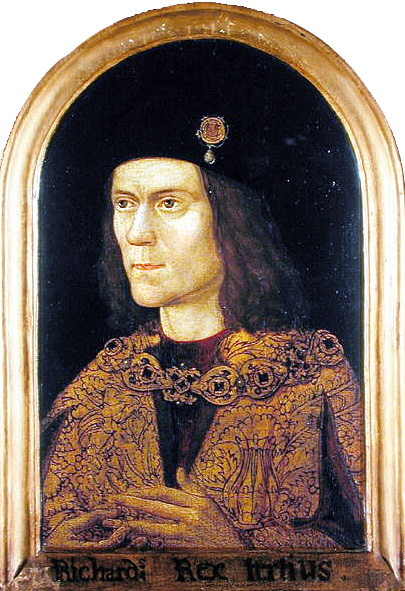
Richard III, King of England (1452-1485) [Wars of the Roses]
By Richard Cavendish | Published in History Today Volume: 55 Issue: 6 2005
Richard Cavendish explains how Archbishop Scrope and Thomas Mowbray were executed on June 8th, 1405.
16th-century painting of Henry IV Henry Bolingbroke took the English throne from Richard II in 1399, with support from the Percy dynasty of Northumberland. He had himself crowned as Henry IV, but things did not go smoothly. The French regime refused to recognize him and the war against them and Owen Glendower in Wales added to the new King’s financial difficulties. His exactions aroused opposition and the Percys rose in rebellion in alliance with Glendower, to be defeated in battle outside Shrewsbury in 1403. Resentment simmered and two years later, Henry Percy, Earl of Northumberland, rebelled again. He was joined by Richard Scrope, Archbishop of York, who came from a leading northern family with close Percy connections. Along with Archbishop Arundel of Canterbury he had ostentatiously welcomed Henry Bolingbroke to the throne. Now he called on the citizens of York to rise against excessive taxation, maltreatment of the Church and the clergy, and corruption in the King’s household. Also drawn in was the nineteen-year-old Thomas Mowbray, Earl of Norfolk, apparently out of resentment at his treament after the banishment and death in exile of his father, the previous earl.
Scrope and Mowbray raised an army of eight or nine thousand townsmen and country people on Shipton Moor outside York. It was not an impressive fighting force, but presumably it was meant to link up with Northumberland’s more seasoned army. Percy, however, failed to move to York to his allies’ support. Henry IV was campaigning in Wales when he heard of the revolt, late in May, and moved swiftly towards York.
On May 29th, meanwhile, Ralph Neville, Earl of Westmorland, one of the most powerful figures in the North, arrived at Shipton Moor to talk to Scrope and Mowbray. Over an amicable cup of wine he assured them that their grievances would be met. At this they told their men to go home and were then astonished and pained when Westmorland had them seized and shut up at Pontefract. King Henry arrived there on June 3rd, refused Scrope’s request for an interview and had the archbishop’s crozier, his badge of office, taken away from him by force after a fierce struggle.
Archbishop Arundel hurried north to plead for clemency, but Scrope and Mowbray were condemned to death by a hastily organized commission of the King’s supporters, Westmorland among them. They were paraded through the streets of York, with Scrope mounted on a mule and ignominiously facing backwards, and beheaded outside the city. The Archbishop comforted the frightened young Mowbray and allowed him to go first. His own head was taken off with five blows of the axe, it was said, recalling the five wounds of Christ. His body was buried in York Minster and there were claims of miracles at his tomb. Mowbray’s head rotted for a couple of months on Bootham Bar.
It did not escape notice that the King promptly fell ill and had to rest for a week at Ripon to recover. He then moved on north to the Percy heartland, but his health took a severe turn for the worse in his later years and word spread that he had been stricken with leprosy as a judgement on him for the Archbishop’s execution. Henry Percy persisted in his opposition until he was finally killed in a skirmish in 1408. Henry IV himself died in 1413.

Archbishop Scrope and Thomas Mowbray Executed | History Today
By Anthony Pollard | Published in History Today Volume: 43 Issue: 9
Anthony Pollard explains how the rivalry of two great Northern families contributed to civil war in fifteenth-century England.
Of all the feuds that beset England in the mid-fifteenth century that between the Percy and Neville families in northern England is the most infamous. A contemporary identified it as 'the beginning of the greatest sorrows in England' and many historians since have perceived it as the critical element in converting factionalism at court into civil war in the kingdom at large. And indeed a direct link between events in Yorkshire in 1453 and 1454, the first battle of St Albans in 1455, and the battles of 1459-61 can be demonstrated. The Wars of the Roses, as they unfolded, were both a contest between the houses of Lancaster and York and a feud between the families of Percy and Neville. But in several respects the character and scale of the feud in the north has been misinterpreted and its real political significance misunderstood.
It has been widely assumed that the Percies were the more important of the two families in the fifteenth century, 'strutting the northern shires like kings'. The ultimate source of the misconception, that the north knew no prince but a Percy, lies in Lord Hunsden's much misquoted remark to William Cecil, made in the immediate aftermath of the Rising of the Northern Earls in 1569, that at that particular moment of rebellion, 'Northumberland knows no prince but a Percy'. Other testimonies to Percy importance, such as the remarks made by Thomas Peeris in the early sixteenth century, or by John Hardyng in 1463, can be shown to be the flattery or special pleading of loyal servants. The actual situation of the Percy family for all but a few years of the fifteenth century was anything but regal. The only Percy to have ruled the north like a prince was the first earl who died in disgrace in 1408. By artful and single-minded political manoeuvring he made him- self the principal power in the north in the reign of Richard II and then, by his timely support for Henry IV in 1399, its master. For a brief while his family, including his brother Thomas, Earl of Worcester and son, Hotspur, were indispensable. But the Percies overreached themselves and rebellion in 1403 and 1405 led to disaster. Condemned for treason in 1405, and his estates forfeited, the earl fled to Scotland. His grandson and heir was restored by Henry V in 1416, but was never able to recover all the family estates or to secure the power and authority enjoyed by the first earl.
Indeed, only once more in the fifteenth century was an earl of Northumberland able to hold sway in the north; in the exceptional circumstances of the eighteen months of civil war between October 1459 and March 1461. But the defeat and death of the third earl at Towton led to attainder and forfeiture for a second time in the century and the fourth earl, though restored by Edward IV in 1471, was kept on tight rein by successive kings until his murder during a tax riot in 1489. The earls of Northumberland in the sixteenth century looked back wistfully to an imagined age when they ruled the north, but in reality they had only ruled it in the later part of the lifetime of the first earl at the beginning of the fifteenth century. It was not the power of the family, but its survival in the male line despite all that had happened to it that was remarkable.
The true princes of the north in the fifteenth century were not the Percies but the Nevilles, or to be more precise, the Nevilles of Middleham. The founder of the family's fortunes was Ralph Neville, 1st Earl of Westmorland, who died in 1425. Unlike the first earl of Northumberland, he was the retainer of the house of Lancaster, but, more importantly his second countess was Joan Beaufort, daughter of John of Gaunt and half-sister of Henry IV.
Unswervingly loyal to the first three Lancastrians, Neville was instrumental in holding the north secure for Henry IV during the Percy rebellions and was the principal beneficiary of their fall. Westmorland, anxious to promote the career of Richard, his eldest son by Joan Beaufort, whom he married to the heiress of the earldom of Salisbury, divided his own inheritance, granting the greater part based on his Yorkshire lordships of Middleham and Sheriff Hutton to Richard. After his father's death, Richard, having successfully with- stood the challenge of the disinherited 2nd Earl of Westmorland, relentlessly extended and consolidated the grip of his branch of the family on the north. Two brothers succeeded to the northern baronies of Latimer and Fauconberg; a third became Bishop of Durham'. He himself was granted the lands of the earldom of Richmond in the north. By 1450, when his son inherited the earldom of Warwick and the lordship of Barnard Castle, he and his family controlled a fifty mile swathe of land in north-eastern England from coast to Pennine ridge and Wensleydale to the Tyne. Added to this were principal royal offices such as the Wardenship of the West March and most of the Duchy of Lancaster stewardships in the north. Not surprisingly, most of the lesser peer- age of the region, including Lords Dacre, Greystoke, Fitzhugh and Srope of Bolton attached themselves to the earl. Richard, now Earl of Salisbury, was continuously adding to and expanding his power with the connivance of a pliant king. He acquired the promise of Richmond in heredity and the office of Warden of the West March for the lives of both himself and his eldest son, as well as the reversion of the remaining steward- ships of the duchy of Lancaster in Yorkshire. Moreover, while Northumberland had great difficulty in securing payment as Warden of the East March, Salisbury enjoyed continued preference at the exchequer. The foundation of this royal favour was his Beaufort blood and his attachment to the ruling faction. The Suffolk of the north, Salisbury was both court politician and overmighty subject.
Henry Percy, 3rd Earl of Northumberland, struggling to rehabilitate his family and to recover full control of his inheritance, was no match for Neville. He dominated Northumberland, where he was the principal landowner and he, or his son, always held the wardenship of the east march. But in both Cumbria and Yorkshire, where he also held estates, he had to accept second place to Salisbury and his family. That the Percies resented the dominance enjoyed by the Nevilles of Middleham in mid-fifteenth century cannot be doubted. Neville had after all, directly benefited from Percy disgrace. But it is not true that mutual hostility between the two families had become a way of life. Indeed there is significant evidence to suggest that until the end of 1452 the two earls worked harmoniously together in defending the border against the Scots, served on royal commissions, co-operated in sponsoring the election of MPs to Parliament, and even agreed to act together as witnesses in the legal transactions of local gentry. The Percies were anxious not to lose out further to the Nevilles.
Such anxiety probably explains the Earl of Northumberland's heavy expenditure on retaining and his jealous protection of his spheres of influence in Cumbria and Yorkshire. In Cumbria, indeed, the Percies gained some compensation. In November 1447 Sir Thomas Percy, the earl's second son, was created Lord Egremont and granted the full barony in face of Neville claims to a share. And in 1452, a brother, William, was promoted Bishop of Carlisle. But until 1453, despite the suggestion that Salisbury as Warden of the March was blamed for the capture of Sir Henry Percy, the earl's eldest son, by the Scots, the tension between the two families remained under control and the Percies offered no threat to continuing Neville domination.
Underlying tension flared suddenly into open conflict in the summer of 1453 because of the marriage between Salisbury's second son, Sir Thomas Neville, and Maud Stanhope, niece and joint-heiress of Lord Cromwell, under the terms of which the manor and castle of Wressle was to pass permanently to a member of the Neville family. Wressle, an ancient Percy manor, once held by Thomas Percy, Earl of Worcester, who had built a magnificent residence there, had been granted to Lord Cromwell. It was one of the properties the Earl of Northumberland had still failed to recover. The prospect of the permanent loss of this small but highly desirable manor to a member of the Neville family seems to have been the final provocation. For the first time, Neville aggrandisement was being made directly at the expense of the Percies. It seems especially to have incensed the impatient younger sons of the Earl of Northumberland, uncertain about their future in a Neville-dominated world. The loss seems to have been felt particularly by the new Lord Egremont, who as yet had neither bride, nor land to match his status and may well have been promised Wressle on its recovery by his father. The outbreak of violence between the Nevilles and the Percies was not, therefore, the culmination of long developing rivalry, but a sudden explosion of pent-up resentment by the younger generation of Percies frustrated by the apparently never-ending expansion of Neville might in the north.
What actually happened in Yorkshire and Cumbria, where violence between the two families also flared up for the first time in 1453, has been exaggerated by historians who have been over-impressed by the melodramatic accounts of contemporaries, by the colourful language of the king's council impotently seeking to control the conflict and by the partisan character of the indictments subsequently made by the victorious Nevilles against the Percies. Violence erupted almost immediately after the king issued on May 1st, 1453, his licence to allow the marriage between Sir Thomas Neville and Maud Stanhope. Egremont began to recruit men and to distribute illegal liveries. He refused several royal commands to submit and so Sir John Neville, another of Salisbury's sons, took matters into his own hands by raiding the Percy manor of Topcliffe. Yorkshire quickly fell into disorder as tit-for-tat attacks on property and retainers ensued, one being the forcible seizure from Gargrave church of Laurence Catterall, a Neville retainer, by Sir Richard Percy.
The culmination of this riotous summer was the attempted ambush in August by Egremont and his brother, Sir Richard Percy, of the Neville wedding party as it passed through Heworth on its way to Sheriff Hutton. By the end of the summer matters had come to such a pitch that both earls were openly drawn into the conflict. They called out their own retainers and on October 20th, faced each other in battle array at Sand Hutton, four miles north of Topcliffe. A fight, however, was avoided by the mediation of the Archbishop of York and both parties were persuaded to suspend hostilities for the winter.
By the summer of 1454 the nature of the conflict was transformed by the intervention of other parties. What in 1453 had begun as a typical aristocratic resort to violence over property and had quickly escalated into a conflict over local domination, became caught up in the factionalism at court and led directly to rebellion in 1455. Matters developed so rapidly because of the collapse of the king's mental health in August 1453 and the consequent confusion and disarray at court. In a series of complex manoeuvres over the winter of 1453-54, the Nevilles ultimately came to back Richard, Duke of York, in his bid to be made Protector of the Realm. There were several reasons for this unlikely alignment. York was Salisbury's brother-in-law, married to his youngest sister Cecily. There is reason to suppose that Salisbury, who was several years older than the duke, had been his mentor when the duke had first entered the political world. But there were more practical and immediate reasons than this. Salisbury himself needed as much as ever to remain close to the fount of royal favour. At the end of 1452 the king had created his half-brother, Edmund Tudor, Earl of Richmond and endowed him at his expense. The alternative to York was Edmund Beaufort, Duke of Somerset, also his kinsman. But Somerset was in dispute with Salisbury's son, the Earl of Warwick, over parts of the Beauchamp inheritance.
The more predictable Beaufort alliance between the Nevilles and Somerset to exclude York and the Percies, both with traditions of disloyalty towards the House of Lancaster, seems to have been precluded by this quarrel. Relationships were made more complex by the ambitions of Henry Holland, Duke of Exeter, an enemy of Lord Cromwell and rival of the Duke of York, who made common cause with the Percies. Thus, because of the tortuous nature of factionalism at a royal court in total disarray the Nevilles came to back the Duke of York rather than the' Duke of Somerset. Indeed it was their backing which effectively secured the protectorate for York in March 1454. There- by they secured their immediate objective of retaining royal favour, but only at the longer term risk of losing it should the king recover in the near future.
The Nevilles gained the instant advantage they sought from the alliance with York. The duke' immediately put the authority of the crown behind them. This was made easier by the open rebellion of the Duke of Exeter in Yorkshire, assisted by Egremont, against his authority as protector. In May, York marched north, accompanied by the Earl of Salisbury, the new Chancellor of England, to crush their enemies. A commission of oyer and terminer sat in York in July, which roundly condemned the Percies for their violence of the previous summer. But little was achieved in restoring order to the county. Late in October 1454, however, Lord Egremont and his brother, Sir Richard Percy, with their followers were engaged by Sir Thomas and Sir John Neville at Stamfort Bridge. The Percy brothers were captured, tried and condemned for trespass, and, as intended, being unable to pay the huge fines placed on them, were committed to Newgate prison as debtors. But the success gained by the Nevilles in the summer of 1454, dependent as it was on the continued incapacity of Henry VI and York's position as protector, was transitory.
At Christmas 1454 the king recovered his senses. York and Salisbury were now exposed to their enemies and could no longer command the court; Somerset and Exeter were restored, and, what is more, for the first time the Earl of Northumberland secured for himself a position of special favour. In March 3.455 York and the Nevilles absented themselves and immediately planned rebellion in order to seize power back. On May 22nd, they attacked the king and his court at St Albans. At the end of the
day the Duke of Somerset and Earl of Northumberland lay dead, and the king and the government were once more in Yorkist hands.It is important to put what went on in Yorkshire in 145W and 1454 in perspective. The violence there did not amount to a private war. This grossly exaggerates the nature and scale of the disorder. Neither Heworth nor Stamford Bridge was a battle. It is not actually clear that blows were struck at Heworth, and Stamford Bridge was a skirmish between two armed gangs, More significant perhaps was the battle that did not take place at Topcliffe in October 1453. Until 1455, in fact, both earls kept their distance; it was their sons who were openly involved. Secondly, although successive royal proclamations and indictments made much of the great 'troubles and vexations' and 'slaughters and murders', there were very few recorded deaths and no Percy or Neville blood was spilled. Indeed, it is the case that in both 1453 and 1454 many of the disorders had no connection with the quarrels between the two magnate families. Sir John Salvin of North Duffield's attack on Margaret Clervaux at nearby Sandholme in Howden in September 1453 arose out of an unrelated dispute over property; the ransacking of Sir John Salvin of Newbiggin's house in Eskdale by Sir Thomas Neville of Brancepeth the following March similarly has no discernible connection with the main conflict. Much lawlessness followed in the wake of the 'great discord' because of the general collapse of royal authority. Even so the scale of disorder pales into insignificance compared with the anarchy which plagued Yorkshire during the winter of 1459-61, as the Percies and their adherents went about the systematic destruction of the 'estates of the Nevilles and their followers.
What happened in the north in 1453 and 1454 was not the culmination of a long feud between Neville and Percy. The disorders were in fact the prelude to a blood feud which did not begin until the Earl of Northumberland was killed in St Albans on May 22, 1455, and arguably did not end until the Earl of Warwick met his death at Barnet sixteen years later. To the blood of the second earl at St Albans was added that of Egremont at Northampton in July 1460. Revenge was wreaked on Sir Thomas Neville and Salisbury himself after Wakefield in December 1460. Those deaths were paid back at Towton in 1461 and Hedgeley Moor in 1464 when the 3rd Earl of Northumberland and Sir Ralph Percy were killed; and finally at Barnet, both Warwick and his brother John were killed in arms against Edward IV whom the fourth earl had tacitly supported. Blood pursued blood, but only after 1455.
The great feud between Neville and Percy was inextricably bound up with the Wars of the Roses. It began as a challenge, born out of the frustration of the younger generation of the Percy family, to the apparently never- ending expansion of Neville power in northern England. It quickly became entangled in the crisis enveloping the whole reign for several reasons. There can be little doubt that the inept kingship of Henry VI had much to do with it. He in the first place allowed the territorial and family aggrandisement of his ambitious kinsman, the Earl of Salisbury. It is likely, however, that had the king remained mentally fit, the earl, with continued royal backing, would have seen off the desperate challenge of the younger Percies in 1453 was his mental collapse in 1453, not his general ineptitude that allowed the quarrel to run out of control.
But there was more to it than the collapse of personal kingship. The crown itself was weak in the north. North of Wensleydale it held very little land, even including the Duchy of Lancaster, and therefore had only a limited direct presence. There remained in northern England, too, a number of seigneurial franchises that severely limited the direct administration of the king's law. In northern Yorkshire, for instance, the bailiffs of Langbaurgh and of the wapentakes of Richmondshire, all appointees of the Earl of Salisbury, carried out the duties and exercised the powers of the king's sheriff. Since the crown also needed to provide for the defence of the border with Scotland, it had little choice but to rule through the local magnates to whom it ceded' a large degree of autonomy. And these magnates, both the Earl of Salisbury and the Earl of Northumberland, were empowered to retain, ostensibly for the defence of the border, on a scale not allowed elsewhere in the realm. Moreover, since they tended to be unchallenged in their own particular zones of influence, whether a county or district focused on a lord- ship, both families enjoyed the sup- port of not only large, but also loyal retinues which maintained a continuity over several generations. Thus both Neville and Percy, but particularly Neville, had the means at their disposal, should they so wish, to disregard or even challenge royal authority. As an individual king, Henry VI compounded the problem, but the crown itself was undermighty in the north. That is why a conflict between Neville and Percy, which the crown was unable to control, threatened the dynasty itself.
To make matters worse both the Earls of Salisbury and Northumberland suffered in mid-fifteenth century from falling rents and income from land. The agrarian crisis of the late 1430s had bitten more deeply in northern England than further south. It led to a permanent fall in rents of some 10 to 15 per cent in the following decade. Thus in the early 1450s both earls were facing financial losses. It was easier for the Earl of Salisbury, with his royal favour, to recoup these from office and prompt satisfaction at the exchequer. For the Earl of Northumberland, spending proportionally more of his income on fees to retainers and having greater difficulty in securing payment of the wages of his garrison at Berwick, denial of such favour had become more critical by 1453. The alienation of Wressle to the Nevilles thus also had real material significance to the Percies. But equally, the retention of favour, by all means available to them, became an absolute necessity for the Nevilles.
Circumstances in the north, therefore, which gave the Nevilles and Percies both independent power and a pressing need for royal favour, conspired to intensify their rivalry for local domination. Who was in and who was out mattered a great deal to the earls, their sons, and their retainers. At first it drove the Percies to violence and disorder; after the realignment of factions during 1454, it drove the Nevilles to rebellion and treason. What made the initial quarrel between Neville and Percy so significant an element in the origins of the Wars of the Roses was not its scale, but its close link with developments at court, as exemplified in the events of 1454. Theirs was not the only aristocratic quarrel, and the north was not the only region in which the house of Lancaster came to grief. But out of this quarrel, which coincided with Henry VI's mental collapse, arose the fateful and unlikely alliance between Neville and York, the decisive conjunction of opposition to the regime which ultimately had the power to bring it down.
In 1454, for ill-considered short-term gain, the Nevilles foolishly put at risk their fundamental advantage of royal favour. Having lost it early in 1455 they were prepared to stop at nothing, including the overthrow of a dynasty to which they owed every- thing, to recover it. Their ruthless pursuit of power led directly to the usurpation of Edward IV, renewed royal favour and the restoration of unchallenged dominance of the north under Warwick the Kingmaker in the 1460s. On the field of Towton seven years later the Neville decision to support York in l454 was finally vindicated.
By Maurice Keen | Published in History Today Volume: 9 Issue: 5 1959
The fifteenth century is without any great chronicle; it has no Froissart, no Mathew Paris to tell its story once and for all. The chronicles of London or of the White Rose are disjointed and fragmentary; many of the most famous incidents of the Wars of the Roses are known to us only through the writings of the Tudor historians. But if chronicle histories are less numerous and less comprehensive than before, in the fifteenth century a new source for historical study becomes for the first time important—collections of private letters. The word private is important; letters have survived from earlier periods, but they are mostly of an official nature—the formal letters of public men about public business. Families like the Pastons and the Stonors, however, who now begin to leave us their correspondence, although locally people of wealth and weight, were not in the forefront of political affairs. They were well-established gentry, the middle people, for whom political events had their sometimes terrible consequences but were were not themselves responsible for them. Their testimony is doubly interesting: not only are their letters a valuable record, they also give us a touchstone whereby to gauge thc reaction of the ordinary, prosperous individual to contemporary events.
Moreover, even in the simple matter of events the letters can furnish us with valuable evidence. Among the Paston letters there is one dating from 1440 that throws interesting light on the negotiations undertaken with France through the Duke of Orleans, who had been a prisoner in England since Agincourt, and on the Duke of Gloucester’s opposition both to his release and to the policy of peace:
“The Duke of Orleans hath made his oath on the sacrament, never to bear arms against England, in the presence of the King and all the Lords, except my Lord of Gloucester, and proving my said Lord Gloucester never agreed to his deliverance, when the mass began he took to his barge.”Throughout the letters, passages like this crop up, giving a sudden and more vivid glimpse of some event of the time.
The Paston letters do not really become important for the political historian until about the time of the fall of Henry VI’s favourite, the Duke of Suffolk. Although they had on occasion suffered at his hands, the Pastons were warmly on the side of their great neighbour; the articles of his impeachment were interesting enough to John Paston for him to preserve a copy of them, and this reaction of his is almost as interesting as the document itself. William Lomnour’s letter to Paston—” a little bill so washed with tears that hardly ye shall read it” —is easily the best account of the Duke’s cruel death on his way to exile, at the hands of pirates.
“In the sight of all his men he was drawn out of the great ship into the boat; and there was an axe and a stock, and one of the lewdest of the ship bade him lay down his head, and he should be fair fared with and die on a sword; and he took a rusty sword and smote off his head with half-a-dozen strokes; and they took away his gown of russet and his doublet of velvet mailed, and laid his body on the sands of Dover.”Again, among the Stonor letters there is an excellent account of the first battle of St. Albans, the first pitched battle of the Wars of the Roses, the most detailed record of it that we possess; while John Payn’s letter to Paston, telling of his adventures at the time of Jack Cade’s revolt, gives as clear an impression as any source of the hardships of that time and the miseries that the rebellion brought to many people of good standing who were involved.
Perhaps as interesting and important as any of the letters is the one that his brother Clement wrote to John Paston on the eve of Towton in 1461, when the Pastons were on the Yorkist side—were, indeed, relying on its success for their good fortune in their litigation over the estate of Sir John Fastolf. “ It is well do, and best for you,” writes Clement, “that ye would come with more men and cleanlier arrayed than another man of your own country would, for it lieth more upon your worship and toucheth you more near than another man of that country, and also ye be more had in favour with my lords here.”
Throughout this period the letters, especially those of the Pastons, are of first-class importance in tracing its tangled history. There is little enough news, it is true, of battles or of fighting, but the regular bulletins from London relations and the general tone show how deeply even a moderate country family was certain to be involved in the struggles of political faction. Sometimes the letters become a primary authority; always they are invaluable in assessing the state of the country and the extent of disturbance.
Every now and again the letters bring us into direct contact with great figures or stirring events—into that kind of personal contact that no chronicle history can ever provide. One might instance the grumbling letter of an English soldier in France, impatient with Henry V’s negotiations with the Dauphin in 1419: “Certes all these ambassadors be double and false. Pray for us that we may come soon out of this unlusty solder’s life into the life of England” — it brings suddenly home the familiar home-sickness of the soldier abroad, and the human life and gossip of the camp in an army in times which, if romantic, are often too distant to come readily to life.
Or there is the letter written by the Duke of Suffolk to his son “giving him very good counsel,” the last letter that he ever wrote, and of which Paston kept a copy, a letter that brings us into touch with one of the greatest men of the time and that must sway any historian who attempts to pass judgment on him. “It is difficult to believe,” as Lingard wrote, “that the writer could have been a false subject or a bad man. There is something pathetic in the ring of it; in the devotion to the monarch who had turned against him:
“Above all earthly thing, be true liegeman in heart, in will, in thought, in deed, to the king our elder most high and dread sovereign . . . charging you, as father can and may, rather to die than to be the contrary, or to know anything against the welfare or prosperity of his most royal person, but as far as your body and life may stretch, ye live and die to defend it.”Look, too, at the parting injunction, to live “in such wise that after the departing from this wretched world here, ye may glorify Him eternally among his angels in heaven. Written of mine hand the day of my departing from this land—your true and loving father, Suffolk.” Little wonder that historians should call William de la Pole “one of the finest types of the old chivalry that was passing away “; his last words in his letter lay bare the tragedy of the servant loyal still in spite of exile and disgrace, a tragedy standing out in all its personal poignancy from the dusty records of faction and intrigue that seem so often to be the stuff of fifteenth-century history.
In quite a different spirit, the letter of Robert Wennington, the West Country pirate, which also comes from the Paston collection, brings us up against a personality; a pirate of the same bold, confident stamp as the adventurers of Elizabeth’s time, Hawkins, Drake or Oxenham, who did not care overmuch for odds when booty was at stake:
“I and my fellowship said, but unless he will strike down the sail, that I would oversail him by the grace of God, and God will send me wind and weather; and they bade me do my worst, because I had so few ships and so small, that they scorned me. And as God would, on Friday last was, we had a good wind, and then we armed. . . and made us ready to oversail them . . . and there yielded all the hundred ships to go with me to what port me list.”It is only when one comes across such a letter as this that one is reminded that the Tudor age grew directly out of the fifteenth century; the spirit that brought it to its greatness was growing up in the years after Agincourt, the battle which more than any other event had awakened a new national consciousness.
Yet if every now and again they illumine some great event and bring it close to us, the general tone of the letters is in a minor key. If they can be at their most useful when they throw light on the incident of politics, the bulk of them do far more to enlighten us about social and economic history, the story of the everyday life of men and women. It would be hard to work up a romance out of the Paston letters; to make them the basis for a nineteenth-century novel of the good bourgeois brought up in comfort and in the most conforming of homes, yet every once in a while confronted with the horrid pains of life, mental and physical, face to face—this would be less hard. Their foci of interest are never earth-shaking.
In the time of William Paston the main theme of the letters is the lawsuit between the old judge and the so-called Prior of Bromholm, John Worte. In the next generation, interest still centres very often in litigation; after the death of Sir John Fastolf in 1459, concern as to the disputes over his inheritance monopolizes more and more attention—indeed John Paston’s interest in politics in this period is very largely governed by regard for his lawsuit. John needed to take good care for his own, especially in the ungoverned period of Edward IV’s struggle with Warwick and the readoption of Henry VI—in 1469 the Duke of Norfolk, pursuing a claim to the Fastolf property, besieged Paston’s castle at Caister with three thousand men.
Curiously enough, the other collections are less important for the political historian than the Paston letters. The Stonors were bigger folk; one of them, John Stonor, had been Chief Justice of the Court of Common Pleas for more than twenty years under Edward III, while the last of them, Sir William Stonor, was with Lord Lovell one of the most important figures in Buckingham’s rebellion against Richard III in 1483. Yet the majority of their letters relate to family affairs and business; the most interesting are those to and from a relative William, who was a merchant of the Staple in the years 1475 to 1480. The main matters of the Plumpton correspondence (the letters of an old Yorkshire family) are again lawsuits and family disputes. The Cely papers come from a family of London merchants and wool-mongers; their greatest interest is for the light they shed on commercial relations with Flanders and on the garrisoning of Calais, where the Celys had a place of business. The letters of John Shillingford, the Mayor of Exeter, are entirely concerned with a suit between the citizens and Edmund Lacy, the bishop, which arose between the years 1447 and 1450. The round of everyday affairs and business is the main concern of all the important collections.
Even thus, out of the limelight, the letters bring the life of the times closer than mere records or accounts ever could, for the personal element is always there. The Celys lay aside affairs when the married merchants of Calais challenge the bachelors to a shooting match.
“And it would please you for your disport and pleasure upon Thursday next coming to may with us . . . ye shall find a pair of pricks of length between the one and other 13 tailor’s yards met out with a line; there we underwritten shall may with as many of you, and shoot with you at the same pricks for a dinner or a supper per 12d a man.”These kind of details, almost modem in tone, abound; Margaret Paston writes to her husband that he will get the stuff for the child’s gown cheapest at Hay’s wife; Jane Stonor writes that she “would rather break up household than take sojournants, for servants be not so diligent as they were wont to be.” On the other hand, there is an endless host of little items to testify to how different a world it was, and with what different assumptions. Shillingford writes home to his fellows, full of naïve and innocent exultation in his own good handling of the justices in their case:
“as my lord Chancellor bade the justice to dinner against that same day saying that he should have a dish of salt fish; I hearing this, I did as methought ought to be done. . . and sent thither that day 2 stately pickerells and 2 stately tenches, which my lord Chancellor made right much thereof. . . for it came in good season, for my lords the Duke of Buckingham and the Marquess of Suffolk and other dined with my lord Chancellor that day.”This is an unfamiliar way of administering justice, but to accuse the good Mayor Shillingford of corruption would be out of place.
Likewise, when we come to marriage, it may startle us for a moment to find Margaret of Anjou, as a girl of barely twenty, writing to Dame Jane Carew, a widow of thirty-six,
“for as much as our trusty and well-beloved squire Thomas Burneby, as well for the great zeal, love and affection he hath to your person, as for the womanly and virtuous governance that ye be renowned of, desireth with all his heart to do you worship by way of marriage; we, desiring the furtherance and preferment of our said squire. . . pray you right affectuously that at reverence of us you will have our said squire towards his said marriage.”
There is plenty about marriage in the Paston letters, but it is nearly always the economic side that looms largest; when Margery Paston married below her station for love, there was a family outcry and the Bishop of Norwich was even called in to dissuade her from this appalling mésalliance. One is glad to know that she won her battle in the end; her love letters are among the most appealing in the whole collection.
The arrangements for a normal marriage were endlessly complicated in the effort to secure the maximum advantage; a marriage agreement in the Trevelian papers even provided compensation in the case of the death of a party before full value had been obtained. “Furthermore provided if it hap the said Elizabeth to decease within twelve months next after the said marriage, that then the said Thomas (her father) shall repay to the said John (Trevelian) 100 marks.”
Even in the smaller, everyday things there is a strange unfamiliarity. Growing up was a much tougher process for children of both sexes than it has since been. Elizabeth Clere writes to John Paston of his young sister, “she was never in so great sorrow as she is now-a-days, for she may not speak with no man how so ever he come . . . and she hath since Easterne the most part been beaten once in the week or twice, and sometimes twice on a day, and her head broken in two or three places.” Agnes Paston’s delicate request to her son’s tutor,” that he will truly belash him, till he will amend,” is only less surprising. All these details, small as they are, remind us that we are moving in a world of quite different conventions; they help the historian to think himself back into a past that is gone beyond recall.
Much of the dead past lies embedded in the letters like fossils in the rock; yet, if there is one feature of them that must be stressed, it is their newness, for they are the first private letters of English people that have survived. This is important; it brings out a side of the century’s history that is often enough forgotten. We are so accustomed to thinking of the middle of the fifteenth century as a period of wild political disorder that we are apt to assume automatically that the arts and learning were also in decline. This impression is quite contrary to the evidence of the letters. The far greater part of them are autograph, even those written by women; and they bear witness to a surprisingly high standard of literacy among the merchant classes and the country gentlemen.
Excited by these suggestive facts Kingsford and others have brought together a clear body of evidence pointing to the steady spread of education, particularly among laymen, during the fifteenth century. It is the period of the foundation of numerous schools and colleges, of Eton by King Henry VI and of Magdalen by Waynflete. In 1446 an ordinance was passed in London limiting the licensed schools to five, but there were in fact many more, and the reason for the measure was the eagerness of parents to send their children to schools, regardless of whether the education they received there was good or bad. The universities of the fifteenth century have been called dead, but this seems to be very far from being exact; if an Italian visiting scholar in 1422 could write that Oxford scholars delighted more in scholastic disputation than in the new learning, and if to Walter Paston the most important aid to obtaining his degree should seem to have been that his guests were satisfied with the banquet that he provided for the occasion, one must not lose sight of men like Flemming of Lincoln or Sellyng, said to have been a fellow of All Souls, both diligent collectors of manuscripts of classical authors, or Thomas Chandler, the Warden of New College, who invited Cornelius Vitelli to come and lecture in Greek at Oxford. Grocyn, who was a student in the college under him, lived to be the friend of Colet, More and Erasmus.
Throughout the period of the Wars of the Roses, the seeds of English culture were growing; there was a new avidity for books in the English tongue. Trevisa’s translation of the old Latin Polychronicon found a ready public; it is significant that most of the contemporary chronicles are in English. John Paston had a dozen or more books of romances, poetry and heraldry, together with the De Senectute and Arnicitia of Cicero; even before the advent of printing many lay gentlemen had small libraries, while some, like Humphrey of Gloucester or Tiptoft, brought together large and valuable collections. The new literacy of the fifteenth century was to flower a hundred years later in the writing of the English renaissance in Elizabeth’s time. Its own literary products, apart from Malory, are banal enough, it is true, but the seed time was necessary for the harvest.
Perhaps it is this attention they call to the fifteenth century as a germinal period that is the most important feature for the historian of the letters that have been here considered. They paint in the background of a period in which two civilizations overlap—a function the more important since if one looks only at the foreground the scene is still altogether medieval. Henry V, sans peur et sans reproche, gallant, pious, “and above all,” says Chastellain, “the Prince of justice,” is the last great king of English chivalry, the pattern of all that was best in the medieval conception of the monarch. Henry VI, pious and often imbecile, is the last king-saint of our medieval history. The vassals, too, be they courteous and wise like Suffolk, or like Warwick, Kingmakers, are medieval figures. The letters show one what is going on beneath this surface; the rise in importance, in education and in ambitions of the smaller folk; their everyday life that continues, very little affected, while the wars rage in the land. The chronicles can spotlight for us the great political events, the falls of kings and princes. The letters do what neither chronicles nor accounts nor public records can do; they bring us into direct contact with the people. They are, in a sense in which the other sources are not, alive, because they are personal records. Whether it is the young Paston at Eton, writing to his elder brother that, “ I may come and sport with you in London a day or two this term time,” or Mayor Shillingford, writing to his fellows in the early morning, full of cheer as ever: “and I lying on my bed at writing of this right yarely, merrily singing a merry song “— whichever it be—it is part of the common human experience, and there is a kind of pleasure in reading it that is not to be sought in the chronicles, be they never so full of rhetoric or of gossip. They can describe the high deeds; but the letters bring ordinary men before us, face to face, for the first time.
By Alan Rogers | Published in Volume: 17 Issue: 3 1967
The Wars of the Roses were no clear-cut dynastic conflict, but rather a series of struggles between the magnates of the age and the retinues they maintained by Alan Rogers. Anthony Pollard offered his own separate historio-graphical analysis in 2010.
In recent years, there has been a considerable revival of interest in the history of fifteenth-century England. It is no longer be the neglected chapter that it used to be; a good deal of work is being done to elucidate the problems of this troubled period, and among them is the nature of the struggles of the middle of the century that have usually been called the Wars of the Roses.
Although it is now generally agreed that the term Wars of the Roses is misleading, that there was no clear-cut struggle between two coherent and consistent parties, there is no agreement yet as to what should replace the traditional version by the Tudor chroniclers of a bitter feud over the crown of England between legitimists and usurpers. Some historians, it is true, assert that there was little widespread disturbance within the realm; but most writers are agreed that there was a period of extensive civil war and disorder over much of the kingdom, certainly from 1450 to 1485 and, on a lesser scale, for many years on either side of these dates. It is clear that there was a bitter struggle between the houses of Lancaster and York, and that from late in 1460 at least it was aimed at the succession to the throne. But the dynastic issue was not the most important aspect of the struggle; by 1460 much of the fighting already lay in the past; and after 1461, although a small legitimist party was created, most of the disturbances had the nature of victors falling out over the spoils. The Yorkist Warwick quarrelled with the Greys and the Woodvilles, not because they were former Lancastrians, but precisely because they were from 1464 such prominent Yorkists. There was nothing in the quarrels after 1461 similar to the problem of the Jacobite movement.
Nevertheless, we need not abandon the term Wars of the Roses entirely, as has been done by some recent historians. The title is no more misleading than the phrase Hundred Years’ War to describe the Anglo-French struggle of the fourteenth and fifteenth centuries; this neither lasted a hundred years, nor was it an unbroken period of warfare. And, at least, the term Wars of the Roses has some merit in that it implies not a single struggle, but many different conflicts with some unifying theme. It is still a useful term for the historian.
But exactly what was this unifying theme? What were the struggles all about? What was it that united the local conflicts between Lord Bonvile and the Earl of Devon in the south-west, between the Percies (especially Lord Egremont) and the Nevilles in Yorkshire, and the struggles between the Duke of York and the Duke of Somerset on a national level? It was not just that the former reflected on a smaller scale the wider conflicts. There was a closer connexion than this, and that was the link of maintenance.
Livery and maintenance are terms that still need much explaining. The magnate’s retinue in the fourteenth and fifteenth centuries was composed of three main groups of persons. First, there were his household and estate servants, officers, clerks and councillors, personal attendants with prescribed duties and rewards paid through their lord’s household. Secondly, and to some extent overlapping with this class, there were those retained by indenture or other formal agreement, a fixed and in general exclusive relationship of a very close nature. But beyond these there was a third group, those who took the lord’s livery—a wide group of tenants, neighbours and dependants who accepted the lord’s fee or badge, looked to him for ‘good lordship’ and supported him in his quarrels. A good deal of attention has been given to the first two groups, rather less to the third group, although it is here that the crux of the Wars of the Roses lay.
The key to the troubles of the middle years of the fifteenth century lay in good lordship. Men sought the patronage of those stronger than themselves. Such patronage, which was declared by the livery, had two results. It enabled the retainer to do what otherwise he was unable to do alone, often to assert his claims with violence against others; and it enabled him to resist similar action of the others by calling upon his good lord for maintenance. When this occurred, the lord’s lawyers helped the retainers with his law suits (maintenance), the lord’s other ‘fee’d men’ provided the soldiery to intimidate the jury and court officials (embraceries), and if necessary an armed force was sent to occupy the disputed property on behalf of the retainer.
Some examples of this may be given. In 1450, Sir William Tailboys of South Kyme, a landowner in central Lincolnshire, was involved in a running dispute with Sir Hugh Wytham of Boston. One of Tailboys’ servants was alleged to have been beaten up by Wytham, who as a Justice of the Peace sent the unfortunate man to Boston prison. Tailboys, who was also a J.P., promptly appealed to his patron, Viscount Beaumont of Folkingham castle, asking for authorization to call out all Beaumont’s men in south Lincolnshire. Wytham in his turn appealed to his good lord, Lord Welles, who was also supported—at least temporarily—by Lord Willoughby and Lord Cromwell of Tattershall castle, near Kyme; Welles committed Tailboys’ servant to Tatter- shall castle and threatened to hang him. The incident promised to grow to even larger dimensions, for behind Beaumont was the Duke of Suffolk, whose influence was felt largely in the north of the county, and behind Cromwell and the others was the Duke of York, whose interests lay mainly in the south—Grantham, Stamford and Fotheringhay nearby in Northamptonshire. What began as a street brawl at Boston could have ended in a national conflict.
This is no isolated example. Exactly similar struggles can be seen in Devon. The burning of the house of Radford, a servant of Lord Bonville, and the killing of its owner by a gang headed by the Earl of Devon’s son, meant that those who had committed the deed looked to the Earl for maintenance, while Bonville, whose good lordship had proved inadequate to prevent the incident, looked for some greater magnate to maintain him and his own retainers and to punish the offenders. The Paston Letters reveal the same struggles, the same search for protection, the same maintenance. Thus, for example, John Heydon, suing John Paston for Gresham, looked to Lord Molyns, while Paston looked to William Waynflete, Bishop of Winchester; and in the later suit brought by Paston against Molyns, the latter was supported by the Duke of Norfolk. Nor is East Anglia unusual in this. The Kent of Lord Saye and Sele, and later of Sir John Fogge, was clearly the scene of struggles for influence and of maintenance similar to those engaged in by Lord Scales, supported by the Duke of Norfolk. In Yorkshire, it was especially hazardous to be without patronage. Westmorland and the west midland shires were similarly affected, and throughout the whole country, disorder resulted from the protection of the weaker by the great.
This is, of course, rather to over-simplify the actual process of maintenance. The career of the Paston family is evidence that the search for good lordship was not always easy nor fruitful; but it also plainly demonstrates that it was necessary. And, in this way, there grew up throughout the country pyramids of power. Lesser men sought the support of the gentry, J.P.’s and well-connected county families. These, in their turn, relied upon the lesser nobility, and they looked for protection to those who wielded political power. How far the incentive for this process came from above or below is not clear. Probably the local magnate, anxious to enlarge his sphere of interest generally within the shire and to control the machinery of local government, cultivated the class which provided the county sheriffs and J.P.s. At the same time, it is evident in the increasing disorder of the period that the members of this very class, each indeed with his own small pyramid, looked for support and maintenance to those above them.
The cause of this process was obviously the break-down of law during the middle years of the century. Disorder was always recurrent throughout the middle ages, and there was a continual struggle of the forces of law and order against violence and self-assertion. The people of medieval England were very litigious; but during the minority and early years of the reign of Henry VI, there seems to have been a collapse of the processes of law on a scale rarely precedented. The unprotected landholder went at his peril; he was open to any trumped-up claim by any gangster who was supported in court or out of court by some ‘good’ lord. He had to find his own protector, his own maintainer.
Nor were such alliances and relationships necessarily permanent and stable. So long as one’s patron gave adequate protection, then it was easy to remain in his retinue, to help maintain him in his struggles. But if it seemed that some other magnate would have more influence, would give greater support, then a change was easily effected. This, of course, had wider repercussions, for one’s opponents would promptly also make a change to secure for themselves better protection and influence. This is what happened when Devon and Bonvile changed their patrons on occasion. In 1461 many ‘Lancastrians’, including the son of the Duke of Somerset, found it politic to get the good lordship of the new Yorkist King. And this was particularly true of the lower ranks of the pyramids. Thus, the groupings throughout the country were in a constant state of change; and those who built up the greatest following of livened (i.a. fee’d) men were those who wielded— either directly or through their own good lords—the greatest political influence.
The middle years of the fifteenth century saw the gradual centralization of these pyramids into two great pyramids only, under the Duke of York and the Duke of Somerset, Gradually, one by one, those not involved were forced to take sides, simply because one or more of their opponents took sides and wielded greater influence against them. And each side was bitterly opposed to the other. It was not just that the pyramids grew up, dedicated to the support of every member within it; such support implied the exercise of influence against someone in the opposing pyramid. For each member of the pyramid brought with him his own personal or family vendettas. The causes of these disputes are complex—personal or family feuds, disputes over offices, land or property, especially inheritance, and the like. Few were entirely free from them. Thus, one man’s profit meant another man’s loss. This was true at all levels of the pyramids. And at the top the Duke of Somerset was bent upon the complete exclusion of the Duke of York from political power; his aim was that the full prerogative of government should be used for himself and his party. York likewise was intent on the destruction of Somerset. To maintain one’s affinity implied the destruction of the other person’s party.
Hence the struggle from 1460 for the crown. For the King did not remain idle in all this. Instead, he threw his weight actively behind the Lancastrians; he maintained Somerset’s pyramid. The balance was upset, and it was probably only the unpopular and politically disastrous actions of the Queen in 1460-1—the open threats of revenge, the sale of Berwick, the use of Scottish troops and the sack of the English towns in continental style—that gave the Yorkists the victory. For men seeking protection from such arbitrary actions, from an attitude that regarded all neutrals as opponents to be punished, rallied to the Yorkist pyramid and left Queen Margaret too weak to take advantage of her strategic victory at Wakefield in December 1460. At Towton, March 1461, the one pyramid smashed the other beyond recovery.
Until late in 1460, there was a neutral party left among the magnates. Such men had moderated Richard of York’s claim to the throne in Parliament in October 1460. But it was clear from the reactions of the Lancastrian group that such a decision was to be regarded as a partisan one. Many of those who joined York in 1461 did so not out of love to York, nor for constitutional principles, but simply to secure protection, maintenance, from a vindictive Queen and her affinity. They fought because they had to; not to have fought would have been more dangerous.
The Yorkist victory in 1461 ended nothing save the Lancastrian pyramid. New groupings arose among the victorious Yorkists, maintenance continued to be necessary. The composition of the Yorkist party in 1461 was in the very nature of things a temporary alliance rather than a permanent grouping of united interests. Rewards from Lancastrian estates given to prominent Yorkists upset once more the balances within the shires, and new feuds arose; new wielders of influence attracted their own pyramids. Until the battle of Tewkesbury in 1471 ended the Lancastrian re-adeption, there was always the complication of a very small legitimist party, mostly in exile with the Queen, the Prince of Wales and Sir John Fortescue; those who had no hope of good lordship from the Yorkists were forced to rely upon a future, rather remote, hope for a Lancastrian restoration. But they were very few. Most men found within the Yorkists new centres of political power—Warwick, the Greys, the Woodvilles, Richard of Gloucester, Lord Hastings, a few even Clarence. So long as good lordship and maintenance were effective, men were reasonably content to support their lord; but when good lordship was partisan or ineffective, then they sought a new lord. It was this tendency that brought Richard of Gloucester to the throne in 1483, for there was no effective good lordship to be had from the young sons of Edward IV; and there was greater fear of the Grey-Woodvile pyramid than unified support for Richard III. And it was a similar tendency that brought Henry Tudor to Bosworth, for his supporters were those who found Richard of Gloucester’s patronage less valuable than the prospects of Tudor success. And it was this problem of maintenance which Henry VII faced and overcame. A measure of his greatness is that he kept himself independent from such groupings, even destroying those of his own supporters like Sir William Stanley, whose influence seemed to be too great to be safe.
This outline is clearly an oversimplification of what was a very complex matter of both national and local history, but it does make some sense out of a confused situation. The Wars of the Roses were no clear-cut dynastic, constitutional or economic conflict, but a series of struggles between affinities, between parties. They affected all levels of society, for all needed protection. Those who supported both sides, like a number of the towns, were following self-interest as much as those who fought clearly on one side or the other. There was no principle involved save that of the preservation of one’s self and one’s property. The disturbances of the fifteenth century as a whole are the Wars of the Roses, and it is maintenance which gives them coherence.
Anthony Pollard visits the History Today archive to examine Alan Rogers’ claim that a lack of principle among rival lords resulted in the great conflagration of 15th-century England.
