By George T. Beech | Published in History Today Volume: 63 Issue: 2 2013
George T. Beech investigates whether a King of Wessex adopted a new name for his country in 828, but failed to implement the change.
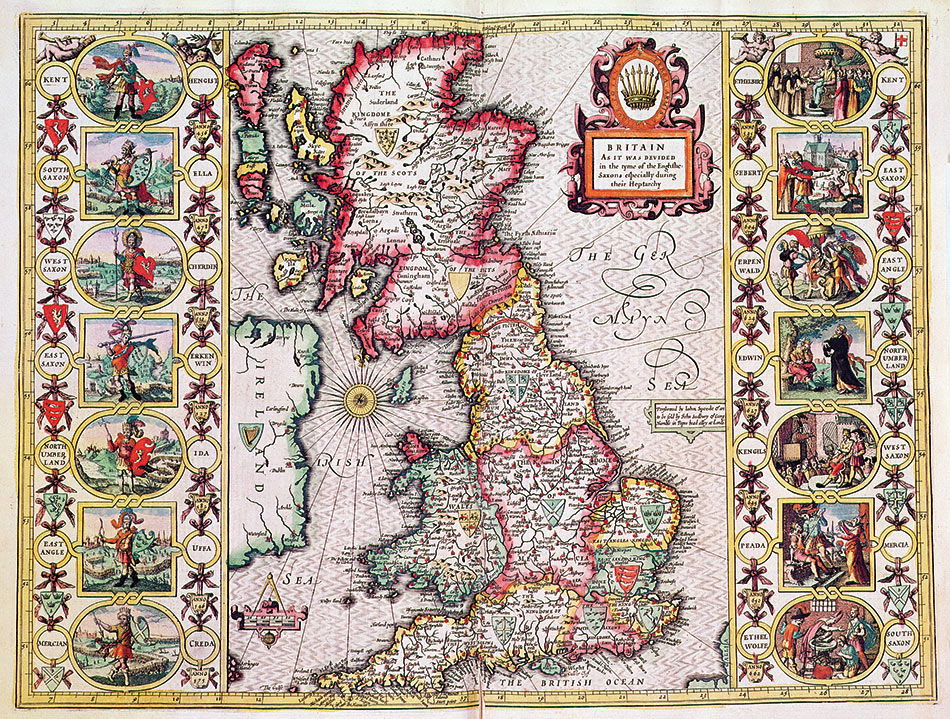
John Speed's 17th-century map, 'Britain as it was Dividied in the Tyme of the Englishe Saxons especially during their Heptarchy'.
In the October 2007 edition of History Today I proposed that people first began to call England by that name early in the 11th century. It was the foreign-born Cnut (r.1016-35) and his advisers who almost certainly promoted this move in an attempt to end the fighting between native English peoples and the Danes by creating a unified country under a single monarch. After having finished that project I was startled to come across the statement of an early 17th-century historian, John Speed, who in his History of Great Britain (1625) wrote:
King Egbert … who by his Edict dated at Winchester an. 819 commanded the same to be called Angle-lond according to the name of the place from whence his ancestors, the Anglo-Saxons, came, which was out of the continent part of Denmarke, lying betwixt Iuitland and Holsatia, where to this day the place retaineth the name Engloen.
Intrigued, I set about looking for this story’s origins. My search led me to an entry for the year 828 in an anonymous Latin chronicle called the Winchester Annals. After describing Egbert’s victory over the Mercians at the battle of Ellendun, the entry reads:
Returning to Winchester he ordered all the leaders of the kingdoms he had conquered to come together with him on a certain day in the city. The people and the clergy came there and with the consent of all groups Egbert was crowned king of all Britain. On that same day Egbert issued an edict that henceforth the island should be called England and that the people, whether Jutes or Saxons, should be called by the common name, English.
Finding out how Speed had learned of this story required uncovering its history from the time of the Winchester Annals down to the beginning of the 17th century. The findings were surprising. Not a single other author from the ninth to the early 14th century cites the story. Then it appears in a Welsh history, the Kings of the Saxons, and in Rannulf Higden’s Polychronicon, or Universal Chronicle (c. 1350). Similarities in wording suggest that both had taken it from the Winchester Annals. After the publication of an English translation of Higden’s work in 1482 a wide variety of authors took up the story, including Robert Fabyan, John Rastell, Polydore Vergil, Richard Grafton and Raphael Holinshed in his Chronicles. This trend continued in the 17th century with William Camden’s Britannia and works by John Clapham and, of course, Speed himself. In the 18th century historians began to question it; 19th-century English historians barely mentioned it; and the story disappeared completely in the 20th century.
Sharon Turner, in his 1799 History of the Anglo-Saxons, is the only previous historian to have investigated the Egbert story. The central questions are: first, where does the story come from, what are its sources? Second, is it factual, truthful, reliable?
The Winchester Annals is a short, anonymous, undated chronicle with entries from the sixth century to the time of the Norman Conquest. It survives today in just two manuscripts, the late 12th-century Corpus Christi College Cambridge 339 and the BL Cotton Ms. Domitian A XIII, the latter a copy of the former. It is now believed that Cambridge 339 is a compilation, the work of a late 12th-century monastic historian in Winchester. What were his sources of information for Egbert’s reign (802-839)?
Earlier writings that would have been available to him and which treat the reign of Egbert start with the ‘A’ manuscript of the Anglo-Saxon Chronicle. This section was begun in Winchester at the end of the ninth century and continued with the late tenth-century history of the Anglo-Saxons by a West Saxon nobleman, Aethelweard. The compiler would also be familiar with several histories written in the 12th-century by William of Malmesbury, Henry of Huntingdon, Symeon of Durham, John of Worcester and Geoffrei Gaimar.
A comparison of the Winchester Annals’ treatment of Egbert with that of these other historians reveals many similarities between them. All present successive episodes in his life and reign: his exile into the Carolingian kingdom as a youth, his accession in 802; his military campaigns, especially his victory over the Mercians at the battle of Ellendun in 825; then his death in 839. The compiler could well have taken much of his information on these subjects from one or other of those earlier writers, from the ‘A’ manuscript, and from William of Malmesbury, in particular. The general agreement between all of these histories on the main outlines of Egbert’s reign points to their overall reliability.
In two respects, however, the Winchester Annals differs noticeably from all the earlier histories. First, in introducing new scenes and developments not mentioned by any of them: Egbert’s enthusiasm for military discipline while in exile in France; his training of young Wessex soldiers after becoming king; its detailed account of Egbert’s battle with Beornwulf at Ellendun; the mocking manner of that Mercian king; the numerical inferiority of the Wessex army; the ghastly slaughter in battle; and Beornwulf’s flight afterwards. Above all there is Egbert’s organisation of his coronation at Winchester in the presence of the princes under his rule and his proclamation of the changing of the names of the people and the country to English and England. Finally it tells how, prior to his death, Egbert made gifts of lands to the church at Winchester. None of these stories, often told in considerable detail, are found in either the Anglo-Saxon Chronicle or the 12th-century historians.
A second distinctive trait is the absence in the Winchester Annals of a number of scenes and events described in the ‘A’ manuscript and copied from it by William of Malmesbury, Henry of Huntingdon and other 12th-century historians: for example, Egbert’s invasion of Wales in 813, his battles with the Danes at Carhampton in 833 and his victory over them at Hingston Downs in 835. The Winchester Annals likewise makes no reference to the ‘A’ manuscript’s comment identifying Egbert as the eighth Bretwalda, who ruled all of Britain south of the Humber, or as William of Malmesbury put it: ‘The sole ruler of almost the whole island, the master of the whole of Britain.’
These differences show that the author of the Winchester Annals used a different source, or sources, which both contained the unique incidents he adds to his account and lacked the ones found in the others. Unfortunately no such earlier history survives, yet modern scholars working from different perspectives have long been convinced that a now-lost work by the same author – often called the Annales Wintonenses deperditi – was an important source of information for a number of early annals such as the ‘A’ manuscript of the Anglo-Saxon Chronicle, which are still in existence today. This could well have been the source of the unique elements in the Egbert story as presented in Cambridge 399, but it is impossible to verify this hypothesis.
Painted stone mural from Old Minster, Winchester, where Egbert was crowned
The inability to uncover the source for the England story does not, however, end all inquiry into its reliability. Another approach is to ask whether the story is consistent with contemporary conditions in Wessex during Egbert’s reign. Is there, for instance, evidence which casts doubts on the likelihood that such a naming change ever took place? To begin with, Sharon Turner noted that no other English historian from the ninth to the 14th centuries, starting with the ‘A’ manuscript, ever mentioned it. Could an event of that nature have passed without comment for so long a period of time? Second, if Egbert had had himself crowned king of England one would assume that he would have taken this title in his official documents. In fact his charters and coins always refer to him as King of the West Saxons, never of England. Turner’s arguments that the story is in effect a fabrication must be considered.
If the story is simply an invention the question arises: who could have invented it, when and for what reasons? I find it hard to believe that the compiler of Cambridge 339, writing three and a half centuries after the event, could have concocted such a story. What could have given him the idea of trying to persuade his readers that the king had made such changes? At best he could have had only a limited knowledge of Egbert’s reign, nothing more than the few lines that he could have read in the histories written about him in the ‘A’ manuscript and by the handful of other earlier historians such as William of Malmesbury. Yet he comes up with a story in striking detail about Egbert’s moves in the days after the victory at Ellendun; his return to Winchester; his calling of the assembly of princes he had conquered, as well as the people and clergy of the town; his having himself crowned; his changing of country names. With regard to the coronation, how could he have thought up the idea that Egbert, who had already been crowned King of Wessex at the time of his accession in 802, could then have had a second crowning as king of all of Britain? A similar question concerns Egbert’s supposed introduction of the names England and English after his coronation. I consider it much more plausible that the complier was simply copying, perhaps literally, a passage he had read in the source from which he was making his compilation, the Annales Wintonenses deperditi.
Another approach to the evaluation of the Egbert naming story is to ask whether there is any evidence favouring its authenticity. As stated earlier the naming story is but one of a number of events or scenes unique to the Winchester Annals and found in none of the other earlier sources such as the A manuscript. Yet directly after telling the naming story the Winchester Annals reports that Egbert made gifts in, or of, six towns and villages in the Winchester region and on the Isle of Wight. This incident occurs only in the Winchester Annals; none of the other earlier histories mentions it. Recently, the historian Heather Edwards pointed to five 12th-century charters extant today in the Winchester cartulary (a roll related to the foundation of institutions), which record precisely these donations by Egbert, leaving no doubt that the compiler had based this part of his history on these very documents. This does not, of course, prove that he also based his naming story on other historical documents, but it warns against assuming that the unique incidents in his account are fabrications.
Then there is a marginal entry in the Cambridge 339 manuscript to the left of the beginning of the Egbert naming story. The main text reads:
Returning to Winchester he [Egbert] ordered all the great people he had conquered to assemble on a given day in Winchester.
The marginal entry (the only one of its kind in the Westminster Annals’ account of Egbert’s reign) is in the same handwriting as that of the main text. It is thus an insertion by the compiler himself and reads as follows:
King Egbert, believing it to be more glorious to be the king of kings rather than of peasants, did not kill the conquered kings but, receiving their homage, made them his tributaries [subjects].
There can be no doubt that this statement is the compiler’s explanation of what has just happened in the story after Egbert’s victories and then his return to Winchester. He wants readers to know that, rather than disregarding – or killing – the princes he had conquered, Egbert preferred to have them present at his coronation so that his people in Winchester would see that these conquered rulers accepted his authority over their countries. Since this was the compiler’s own comment on the story he did not integrate it into the narrative but put it into the margin to the left. This strongly suggests that the Egbert naming story was not his invention, but was part of an account he was copying into his annals from another source. He would hardly have made a comment of this kind if he had himself fabricated the story.
The most basic reason for doubting the authenticity of the naming story is its apparent inconsistency with what is known about Egbert’s reign as a whole. How could a ruler of Egbert’s stature have conceived a project to call himself king of all of Britain and then rename it as England? To be sure, Egbert’s recent conquest of Mercia, Wales, Kent and East Anglia had made him ‘the ruler of everything south of the Humber, and he was the eighth king who was Bretwalda’ (overlord). Yet the chronicler of the ‘A’ manuscript, who wrote this in his anal for 829, said nothing about Egbert changing the name of his kingdom to England. Where could such an idea have come from? One possible answer is the influence of one of the most famous coronations and political moves in the history of early medieval Europe. On Christmas Day 800 in the Basilica of St Peter’s in Rome, two years before the beginning of Egbert’s reign, Charlemagne had himself crowned Holy Roman Emperor in his attempt to revive the Roman Empire of antiquity in his kingdom in western Europe. In certain respects the story of Egbert’s coronation and renaming his people and country resemble Charlemagne’s actions. In both cases a reigning king had himself recrowned and changed his title: Egbert, previously King of Wessex, now became King of Britain and changed its name to England.
No explicit evidence of such mimicking survives, yet a number of factors suggest this possibility. Charlemagne had contact with several English monarchs, some of whom visited him at his court in Aachen. As a youth, Egbert, heir apparent to the throne of Wessex, was forced into exile for several years in Charlemagne’s kingdom and may well have stayed at the Carolingian court. If so, he may have witnessed Charlemagne’s coronation in 800. During that exile he was so impressed by ‘the art of government … (of) … the Franks’ (from William of Malmesbury), that he adopted Frankish military customs and discipline for himself, then later, after becoming King of Wessex in 802, he trained his own soldiers in this way. Charlemagne, whom Egbert may have known personally, could have had a role in Egbert’s return to England and in his accession to power as king in 802. In 839 Egbert may have sent a legation to the court of Louis the Pious, Charlemagne’s son and successor and in 856 Aethelwulf, Egbert’s son and successor, married the daughter of Charles the Bald, Charlemagne’s grandson and Carolingian emperor at the time. Nothing proves that Egbert modelled his behaviour of 828 on that of Charlemagne in 800, yet relations must have existed between the two royal courts and the possibility that Egbert might have been influenced in this way casts his reign and the naming story in a new light.
The most compelling reason for rejecting the Egbert naming story is certainly the fact that, as Sharon Turner pointed out in 1799, no English historians or documentary sources from the ninth to the early 14th-centuries ever mention it. If Egbert had indeed changed the name in a public ceremony, how could it be that no one other than the Winchester Annals reports it? The only possible explanation is that the change lasted only briefly and never took permanent effect and there are reasons for believing that this is what may have happened. In the 830s, shortly after the coronation and name change according to the Winchester Annals, a resurgence of Mercian power under King Wiglaf (d.839) ended Egbert’s control of that kingdom and at the same time his rule over Essex and Wales also came to an end. In 835 Viking raids threatened the west coast of Wessex. In 830 Louis the Pious may have withdrawn his support due to internal troubles in his kingdom and that may have further weakened Egbert’s cause. These developments would have put an end to Egbert’s hope to be the ruler over the entire country. Consequently the name change, which had been in effect for only three or four years, may have been abandoned and later forgotten. Forgotten, that is, by all save the author of the naming story as we know it today. This man, possibly a contemporary observer in Winchester, could have written it down and it could subsequently have been incorporated into the now lost chronicles from which the late 12th-century compiler brought it into the Winchester Annals as it survives today in the Cambridge 339. That the story survived in only two manuscripts, both probably kept in monastic archives of limited access, may explain why no English historians for five centuries knew of it or referred to it.
I am inclined to believe that this name-changing incident as recounted in the Winchester Annals in fact occurred in Winchester in the late 820s when Egbert, inspired by Charlemagne’s creation of the Holy Roman Empire, sought to create a new monarchy of England on this model, but that unanticipated defeats cut short his project. Thus the name change never took hold and subsequently all memory of it was lost until the 14th century. What I am proposing lacks proof, yet this theory explains why the country’s name did not change from Britain to England, despite Egbert’s order.
This had no effect on the story’s spectacular rise to prominence among the English people from the 15th to the 17th centuries. After Higden discovered and promoted it in the 14th century, it became the standard account for the origins of the name England among educated people. Then in the 18th and 19th centuries it was rejected and fell into oblivion. There are doubtless other stories connected with the English/British past that similarly came to prominence and then were cast aside, but do any of them match the trajectory of the Egbert story?
If my analysis has solved the problem of the Egbert naming story, this finding modifies only slightly our knowledge of the origins of the naming of England. It is not Cnut in the early 11th century, but Egbert of Wessex two centuries earlier who will have been the first person to attempt to introduce the name. Egbert’s failure to enforce this renaming means that my earlier argument about this having been brought about by Cnut between c.1014-20 remains valid. Of greater interest is what this story reveals about Egbert’s conception of the royal office in the early ninth century: that he saw himself as the ruler of a single English people of a unified nation at a significantly earlier time than was previously thought.
George T. Beech is Professor Emeritus of Medieval History at Western Michigan University, Kalamazoo.

By Professor Edward James
Last updated 2011-03-29
 | The story of the Vikings in Britain is one of conquest, expulsion, extortion and reconquest. Their lasting legacy was the formation of the independent kingdoms of England and Scotland. |
Viking raids
Raids by seaborne Scandinavian pirates on sites in Britain, especially largely undefended monastic sites, began at the end of the eighth century AD.
By the end of the ninth century there were large-scale settlements of Scandinavians in various parts of Britain, and they had achieved political domination over a significant territory.
Early in the 11th century the king of Denmark became king of England as well. And in 1066 there were separate invasions by the king of Norway, Harald Hardrada, and duke of Normandy, William, the latter the descendant of Scandinavian settlers in northern France.
Many monasteries in the north were destroyed, and with them any records of the raids.
Yet the most significant development of the period was an indirect result of Scandinavian involvement in the affairs of Britain - the emergence of two kingdoms of newly unified territories, England and Scotland.
In 793 AD, an anguished Alcuin of York wrote to the Higbald, the bishop of Lindisfarne and to Ethelred, King of Northumbria, bemoaning the unexpected attack on the monastery of Lindisfarne by Viking raiders, probably Norwegians sailing directly across the North Sea to Northumbria.
It is clear from the letter that Lindisfarne was not destroyed. Alcuin suggested that further attack might be averted by moral reform in the monastery.
Over the next few decades, many monasteries in the north were destroyed, and with them any records they might have kept of the raids. We know no historical details of the raids in Scotland, although they must have been extensive.
Iona was burnt in 802 AD, and 68 monks were killed in another raid in 806 AD. The remaining monks fled to Kells (County Meath, Ireland) with a gospel-book probably produced in Iona, but now known as the 'Book of Kells'.
Other monasteries in Scotland and northern England simply disappear from the record. Lindisfarne was abandoned, and the monks trailed around northern England with their greatest possession, the relics of St Cuthbert, until they found a home in Durham in 995 AD.
England and Scotland
We cannot be sure of the impact the Vikings had on Scotland due to a real scarcity of written material from the area. But the surviving place names show us that the Orkneys and Shetlands, and the mainland of Caithness and Sutherland, were heavily settled by Norwegians.
Those Norwegians were probably involved in the greatest political upset in the north - the disappearance of the kingdom of the Picts.
The Vikings began to assemble larger armies with the clear intent of conquest.
In the eighth century, the Picts had one of the most important kingdoms in Britain. By the end of the ninth century they had vanished. In their place was a kingdom of Scotland, controlled by the Scots, who were the descendents of immigrants from Ireland in the fifth and sixth centuries.
The Scots took advantage of the presence of the Vikings, and, above all under King Cináed mac Alpín (Kenneth MacAlpine), they did so with considerable aggression and intelligence. They promoted themselves as the kings of all those in northern Britain, or 'Alba'.
They wove a new national history, which emphasised (or invented) many links between the Scottish and Pictish dynasties. They also promoted the idea that St Columba, the founder of the monastery of Iona, was the apostle of all those in the north.
The Viking raids in England were sporadic until the 840s AD, but in the 850s Viking armies began to winter in England, and in the 860s they began to assemble larger armies with the clear intent of conquest.
In 865 AD they forced the East Angles to help supply an army, which in 866 AD captured York and in 867 AD took over the southern part of the kingdom of Northumbria.
Later traditions saw Ragnar Hairy-Breeks and his son Ívarr the Boneless as the two main Viking leaders, responsible not only for killing Ælla, King of Northumbria in 867 AD but also Edmund, King of the East Angles in 869 AD, and for destroying Dumbarton, the fortress of the British kings of Strathclyde.
The normally reliable 'Annals of Ulster' recorded Ívarr's death in Ireland in 873 AD and described him as 'king of the Northmen in the whole of Ireland and Britain'.
The man we then see more clearly in the sources as the Viking leader, Hálfdan, was later believed to be Ívarr's brother. He led the Viking army to a conquest of Mercia in 874 AD, organised a parcelling out of land among the Vikings in Northumbria in 876 AD, and in 878 AD moved south and forced most of the population of Wessex to submit.
The Vikings had conquered almost the whole of England.
Alfred's dynasty
 |
| An excerpt from the 'Parker Chronicle', the oldest surviving manuscript from the 'Anglo-Saxon Chronicle' (890 AD) © |
The idea that the Vikings had forced Wessex to submit may have been invented to magnify the achievement of its king, Alfred, the only English king to be called 'the Great'.
Famously, he hid in the marshes near Athelney (Somerset) in 878 AD, but then emerged, re-formed his army, and defeated the Vikings later that year at Edington (Wiltshire).
After the peace that Alfred forced on the Vikings, the Viking army seems to have moved across the Channel (it established winter quarters in Paris in 886 AD), giving the king some time to organise for war.
Æthelstan's victory did not end the Viking threat or the slow expansion by the Scots.
He built fortresses, established a defensive strategy, and built up a navy. By the time the Vikings returned in the 890s, the West Saxons were able to resist, leaving Alfred, at his death in 899 AD, king of the only independent English kingdom.
Thanks to Alfred's own propaganda machine, we know more about him than about most early medieval kings in Britain. He ordered the compilation of the 'Anglo-Saxon Chronicle', a major source of information that was continued as contemporary chronicles in various centres until the 12th century.
Under Alfred's auspices, the Welshman Asser prepared a 'Life of Alfred', after the model of Einhard's 'Life of Charlemagne'. Like Charlemagne, Alfred was deeply interested in promoting literacy and learning, and he sponsored (and perhaps even took part in) the translation of various Latin works into English.
Alfred was succeeded by his son Edward the Elder (899-924 AD) and grandson Æthelstan (924-939 AD). Both these rulers were in many ways even more important in the history of England than Alfred himself.
In a few expeditions Edward (with the direct military help of his sister Æthelflæd, widow of the Mercian king) conquered the south of England from the Danes, and incorporated Mercia itself into his kingdom.
The 'Anglo-Saxon Chronicle' tells us that Edward built a fortress at Bakewell (Derbyshire), and there he was chosen 'father and lord' by the king of the Scots, the king of the Strathclyde Welsh, and the people of Northumbria.
All of them were perhaps in need of protection from aggression by the Vikings of Dublin.
There was a similar submission to Æthelstan in 927 AD, at Eamont (Cumbria), when Welsh kings as well as the Scottish king submitted to him. The great Welsh king Hywel Dda (Hywel the Good) was apparently a close ally. In fact, he was so Anglophile that he named one of his sons Edwin, and sponsored a written law code after the English model.
Æthelstan's greatest success was the victory at Brunanburh, somewhere in the north. A Viking army led by Olaf Guthfrithson, allied with the kings of Scotland and Strathclyde, invaded Northumbria in 937 AD. Our source tells us that five kings and seven of Olaf's earls died on the battlefield, as well as the son of Constantine II of Scotland.
Æthelstan's reputation was immense on the continent, and an Irish monk called him 'the pillar of the dignity of the western world'. But his victory did not put an end to the Viking threat in the north, nor to the slow expansion of the power of the Scots.
The last Viking king of York, Eric Bloodaxe, was only expelled from Northumbria in 954 AD, after Æthelstan's rule. In that same year the Scots took Edinburgh from the English.
Danegeld
After 955 AD there was a generation of peace on the island of Britain. As the 'Anglo-Saxon Chronicle' says of Edgar, King of England (959 - 975 AD) 'without battle he brought under his sway all that he wished'.
He issued laws for 'all the nations, whether Englishmen, Danes, or Britons', an interesting recognition of the multi-ethnic character of England at the time.
Edgar took advantage of his strong position to foster the reorganisation of the church that is generally known as the '10th-century Reformation'. New bishoprics were established in the areas conquered from the Vikings.
Raids were on a large scale and their object was extortion.
But above all this reformation was about the re-establishment and strict reform of monasticism.
Edgar relied on three men in particular - Dunstan (archbishop of Canterbury, 960 - 988 AD), Oswald (bishop of Worcester, 961 - 992 AD, and archbishop of York, 971 - 992 AD) and Æthelwold (bishop of Winchester, 963 - 984 AD).
The process was sealed by the 'Regularis Concordia' of 973 AD, a document of monastic reform that relied heavily on continental models. It was cemented by the building of some magnificent churches (mostly replaced by the Normans) and some lavish illuminated manuscripts, such as the 'Benedictional of St Æthelwold'.
After Edgar's death, his successor Edward I reigned briefly. He was murdered in 978 AD at Corfe (Dorset), possibly by the followers of his young half-brother Æthelred, and possibly by his stepmother.
Edgar's half-brother, Æthelred II, who later would acquire the nickname 'the Unready', started his long reign (978-1016 AD) at the same time as the emergence of Denmark.
The country was newly converted to Christianity and newly unified under Harald Bluetooth. It was becoming a major power.
This was the dawning of the 'second Viking age', and it was very different from the first. Raids were on a large scale, frequently organised by royal leaders, and their object was extortion. In 991 AD the Danes acquired 4,500 kg of silver in return for going home.
By 1012, payments to the Danes, known as 'Danegeld', had increased to 22,000 kg. England was wealthy, and it developed a taxation system that was probably more sophisticated than any other in Europe, which was both a cause and a consequence of the raiding.
Conquest and fall
 |
| Silver penny of Cnut (Canute) © |
The extortion came to an end in 1013, when Harald's son, Swein Forkbeard, decided to conquer England. He forced Æthelred into exile, although the definitive conquest of England was only achieved under his son Cnut (or Canute).
In 1016, Cnut became king of England, and after further campaigns in Scandinavia he could claim in 1027 to be 'king of the whole of England and Denmark and Norway and of parts of Sweden'.
William won and the last English royal dynasty perished.
Cnut was a strong and effective king. He introduced some Danish customs to England, but England also influenced Denmark. For instance, Cnut appointed several Englishmen as bishops in Denmark, and even today most of the ordinary Danish words of church organisation are English in origin.
In an attempt at reconciliation with the English he had conquered, Cnut married Emma, the widow of Æthelred. She was the daughter of the duke of Normandy, himself the descendant of Vikings or Northmen (Normans).
She bore Cnut a son, Harthacnut, but she had also had a son by Æthelred, who succeeded Harthacnut as Edward II, the Confessor (1042 - 1066).
When Edward died without children, it was natural that Emma's great-nephew, Duke William, should lay claim to the throne. It was just as natural that this claim should be resisted by Harold, the son of Godwin, Edward's most powerful noble.
Harold II successfully beat off the invasion by Harald Hardrada of Norway, defeating him at Stamford Bridge near York in September 1066. Even when he and his troops arrived, exhausted, at Hastings three weeks later to face William's Norman invaders, he nearly prevailed.
But William won, and the last English royal dynasty perished.
Find out more
Books
From the Vikings to the Normans (Short Oxford History of the British Isles) edited by Wendy Davies (Oxford University Press, 2003)
Britain in the First Millennium by Edward James (Edward Arnold, 2001)
Early Medieval Ireland, AD 400-AD 1200 Dáibhí Ó Cróinín (Longman, 1995)
Scotland: Archaeology and Early History Graham Ritchie and Anna Ritchie (Edinburgh University Press, 1991)
The Oxford Illustrated History of the Vikings edited by Peter Sawyer (Oxford University Press, 1997)
Unification and Conquest: Political and Social History of England in the Tenth and Eleventh Centuries by Pauline Stafford (Hodder Arnold, 1989)
About the author
Edward James is Professor of Medieval History at University College Dublin. Previously he had been Senior Lecturer at the University of York and Professor of Medieval History at Reading. He has published a number of books and articles on early medieval France, including The Franks (Blackwell, 1988) and is currently writing a book called Europe's Barbarians for Longman.
By Russ Foster | Published in History Review
Russ Foster asks whether the legend of the heroic king is simply too good to be true.
The market town of Wantage in Berkshire is dominated by a lifesized statue of its most famous son, Alfred, the fifth surviving son of King Aethewulf of Wessex, born in 849. As well as a statue, the Victorians who erected it provided him with an incomparable curriculum vitae:
Alfred found learning dead
And he restored it
Education neglected
And he revived it
The laws powerless
And he gave them force
The church debased
And he raised it
The land ravaged by a fearful enemy
From which he delivered it
Alfred’s name will live as long
As mankind shall respect the past
Perhaps mankind’s respect for the past has diminished over the past century. It is certainly true that, though Alfred’s name remains familiar, his standing in the national pantheon has slipped considerably. Whilst he did not even make the top ten in a millennium poll of the greatest Britons in 2000, those commemorating the thousandth year of his death in 1899 hailed him as the founder of the nation and saviour of its Christian faith. More esoterically, he was credited as being the inventor of the candle clock, founder of Oxford University and the Royal Navy, even putatively of the British Empire. Were the Victorians really so wrong?
Alfred the Soldier: the war on terror
In 849 ‘England’ comprised a heptarchy of kingdoms of which Northumbria, Mercia, East Anglia and Wessex were the most powerful. Wessex’s pre-eminence by the time of Alfred’s birth owed most to the efforts of his grandfather, Egbert (802- 839), and father, Aethelwulf (839-858). They expanded Wessex to include most of England south of the Thames except Mercian-controlled London. For half of Alfred’s lifetime, however, the accent was less on the expansion than the survival of Wessex because of the increasingly dangerous attacks from Scandinavia by those we now popularly remember as ‘Vikings.’ A translation more accurately conveying the terror the invaders conjured in the minds of Christian Englishmen would be ‘Pagans.’ Something of that terror is conveyed in the contemporary prayer ‘From the fury of the Northmen, Good Lord deliver us.’ In 865 the ‘Great Army’ of Vikings landed in England. Within a decade they had subjugated Northumbria and East Anglia and installed a puppet ruler in Mercia. Wessex would surely follow.
After Aethelwulf ’s death Wessex had been ruled in turn by Alfred’s three elder brothers. The third of these, Ethelred (865-871), regarded Alfred as his trusted lieutenant. The two together confronted the pagan invasion when it came in 871. Although they inflicted a notable defeat on the invaders at Ashdown, they failed to prevent the pagan advance into the heart of Wessex, at which dangerous juncture Ethelred died. One of Alfred’s first acts as king was to buy his enemies’ departure: presumably Wessex had resisted enough to convince them that easier pickings in the short term lay in Europe.
Alfred’s respite was relatively brief. Pagan forces returned in 876-877. Then, early in 878, an army led by King Guthrum took Alfred unawares at Chippenham. Though he escaped capture, his hold on Wessex hung by a thread, whilst he took refuge in the Somerset marshes on the Isle of Athelney. For weeks, all he could do was conduct a guerrilla-style resistance, fortunate that another invading force which threatened his base was destroyed on the north Somerset coast by Earldorman Odda. Only in early May did Alfred feel strong enough to rendezvous with the fighting men of Wessex and engage Guthrum in open battle. The resulting victory at Edington proved the most decisive encounter of his reign: it paved the way for the Treaty of Wedmore with Guthrum, who agreed to be baptised as a Christian.
Magnanimity in victory was accompanied by hard-nosed realisation that only greater preparedness would guard against renewed calamity. Alfred spent the remainder of his reign constructing at least a rudimentary navy. He also oversaw an administrative reorganisation of the Wessex military machine, hitherto not unlike the modern territorial army, in order to render it more effective. Above all, he gave orders for the construction of a series of over 30 carefully-sited burhs, garrisoned and fortified settlements which would afford protection to his people and the ability to disrupt further invading forces.
Future attacks on Wessex duly took place, in particular by the ‘Great Horde’ which plagued Wessex from 891 until the remnants of it disintegrated in 896. But dangerous though this was, it was never a plague that threatened to spread a fatal contagion. Alfred reaped the benefit of his reforms, harrying an invader who never succeeded in wresting the military initiative from him. At his death Wessex, which now included London, was twice as large as the kingdom he had inherited.
Alfred the Scholar: education, education, education!
The best-known story of Alfred’s early life involves a book of poetry belonging to his mother. She promised it to whichever of her sons could recite it first. The youngest, Alfred, won the prize. The vignette may be apocryphal but Alfred undoubtedly loved learning for its own sake: ‘I cannot find anything better in man than that he know, and nothing worse than that he be ignorant,’ he said. He aspired perhaps to be a new King Solomon, or a second Charlemagne (768-814), the great Frankish soldier-scholar. This involved more than simply royal patronage of learning. Alfred played a direct part in what Abels calls ‘a systemic overhaul of religious and educational life’ in Wessex. This was the more remarkable because he was at best semiliterate before the 880s and chose to learn Latin in adulthood from scratch. His wider purpose was achieved by recruiting a coterie of distinguished clerical scholars to his court: Plegmund from Mercia, Grimbald from Rheims and, most significantly, Asser from Wales. The great project he set for them was to provide vernacular translations of books ‘most necessary for all men to know’. The major achievements were Gregory the Great’s Pastoral Care, Boethius’s Consolation of Philosophy and St Augustine’s Soliloquies. At court a school was established to instruct the children of the nobility – the future governors of Wessex – in the liberal arts. The great law code which he subsequently issued required ealdormen and reeves to learn to read on pain of losing their offices. It could hardly have been lost on him that a better-educated elite would facilitate the kingdom’s defence.
A complementary, if not even more important motive, in driving Alfred’s educational programme was religion. He believed that the moral failings of the people had led to the punishment from God that was the Vikings. Certainly this much is implied in his translation of Pastoral Care. In it he paints a grim picture of the church and the state of learning which existed before the Northmen descended. Part of his conception of his duty as a Christian ruler was to atone for these shortcomings and, by so doing, restore to his people both wisdom and happiness.
What this all amounted to in reality, it must be admitted, is impossible to gauge. There was no great religious revival. Alfred’s father, Athelwulf, was a more pious man than he: Alfred only founded two modest religious houses, at Athelney and Shaftesbury. One bishop even dared to criticise him privately to the pope for not having done enough to crush paganism beyond his kingdom. But in the decade or so available to him he had perhaps done as much (or more) as could reasonably be undertaken. The most suggestive clue is the so-called Alfred Jewel discovered near Athelney in 1693, which may well be one of the aestels (or pointers) which he promised to send to every diocese with a copy of Pastoral Care. It provides in itself substance to Keynes and Lapidge’s claim that his later reign witnessed ‘nothing less than a cultural renaissance’.
And Alfred Alfred the Great?
That evaluations of Alfred have tended to be favourable owes much to the nature of the source material for his reign. Both his law code and his translations provide insights into the mind of the king. Crucial too is the Life written by Asser, the scholarly Welsh monk who became his friend. though incomplete (it appears to have been written in about 893), there is simply no comparable source for a pre-Conquest monarch. Indeed, as it is so remarkable and as there is nothing close to an extant original, its authenticity has often been questioned. the consensus remains that it is genuine, if for no other reason than that a convincing motive for its having been a tenth or eleventh century forgery has not been established.
Much of Asser’s Life is a plagiarism of various medieval manuscripts known today as the Anglo-Saxon Chronicle. It is plausible that Alfred patronised a formalised version of it in the 890s as part of his wider vision for educational reform. Whether true or not, it patently exhibits a Wessex bias in general and an Alfred bias in particular, of which the modern reader must be wary. Thus, whilst we are treated to a relatively detailed account of Alfred’s triumph at Ashdown, his various defeats are usually referred to euphemistically as engagements where the pagans were left in control of the battlefield. Similarly, it is quite possible that the magnitude of Alfred’s plight in 878 has been overdrawn in order to make his subsequent victory the more heroic.
Caveats about Alfred’s greatness are also suggested by questions of perspective. His contemporaries were not always impressed: Asser records Alfred’s frustration that people were reluctant to make the sacrifices necessary to effect his plans for reforms. Clearly, too, Wessex was only in a position to resist invasion in the first place because of the earlier efforts of his brothers, father and grandfather. In his own reign he owed much to loyal subordinates such as earldorman Odda. And Alfred today is rightly styled as King of the West Saxons. The re-conquest of the Viking controlled Danelaw only came about in the reigns of his son, Edward the Elder (899-924), and grandson, Athelstan (924- 939). The latter, in defeating the northern Vikings and their Scottish allies at Brunanburh in 937, might meaningfully be styled as King of England.
The fact remains, however, that Alfred and Wessex alone survived the mid-ninth century pagan onslaught. The Anglo-Saxon Chronicle was right to describe him when he died as king of those english not under pagan control. The idea of ‘England’ had clearly been advanced during his reign. Even if there had been no Viking threat, his interest in, and contribution to, learning would mark him out as an unusually distinguished Anglo-Saxon king. But there was a Viking threat which he countered triumphantly. It is thus the sum of his parts that makes Alfred remarkable, suggesting that the sobriquet attached to him first by the elizabethans may not be so very far from the mark. The best epitaph is provided by words he himself wrote in his translation of Boethius: ‘I desired to live worthily as long as I lived, and to leave after my life, to the men who should come after me, the memory of me in good works.'
Russ Foster is Head of History at Hampshire Collegiate School in Romsey.
Further reading:
- Richard Abels, Alfred the Great: War, Kingship and Culture in Anglo-Saxon England (Longman, 1998)
- Simon Keynes and Simon Lapidge, Alfred the Great: Asser’s Life of King Alfred and other contemporary sources (Penguin, 1983)
- H. R. Loyn, Alfred the Great (Oxford University Press, 1967)
- Justin Pollard, Alfred the Great: The man who made England (John Murray, 2005)
- Timothy Reuter (ed.), Alfred the Great: papers from the Eleventh-Centenary Conferences (Ashgate, 1999)
- Alfred P. Smyth, Alfred the Great (Oxford University Press, 1995)
- David Sturdy, Alfred the Great, 1995 (Constable, 1995)
